Who you gonna call?

SKYWARN logo

If you read this blog regularly, you know that the northern Indiana office of the National Weather Service has been supplementing live and online independent-study SKYWARN storm spotter training with “chats” via Facebook and Twitter.

During one of the Facebook chats, a spotter asked an excellent question: If he sees a tornado, should he call the NWS first, or 911? The spotter reasoned that if he calls 911, local public safety officials would learn of the tornado and would relay the report to the NWS.

The NWS replied that they’d prefer to get the first call. This makes a lot of sense, for the following reasons:

  • 911 call centers get very busy answering calls and dispatching emergency responders during severe weather. They are often so busy, they don’t have time to call the NWS with the reports they receive. We should never assume that a report made via 911 will get to the NWS.
  • 911 call centers might be able to activate tornado sirens, but they cannot issue the official tornado warning that triggers NOAA Weather Radio (NWR) alerts, broadcast radio or TV alerts or cell phone wireless emergency alerts (WEA).
  • The NWS, on the other hand, can issue the official tornado warning, which will go to the 911 center, the broadcast media and directly to the general public via multiple channels, including NWR, WEA, smartphone apps, etc.

There can be an issue, however, with calling the NWS. Sometimes, their unlisted spotter report line is busy when spotters call, especially during a widespread event. That’s one reason that the NWS increasingly suggests that trained storm spotters use Twitter (include @nwsiwx or #nwsiwx in your tweet) or Facebook to send reports. These social media channels also allow spotters to add credibility to their reports by including photographs. During periods of severe weather, NWS monitors Twitter and Facebook constantly, so a social media report can actually reach meteorologists faster than a telephone report, especially if the phone line is busy.

Of course, for spotters who are also ham radio operators, ham radio SKYWARN nets provide another alternative to telephone and social media. And ham radio transmission allows other radio-equipped spotters to hear reports as spotters make them.
Better alternatives to tornado sirens

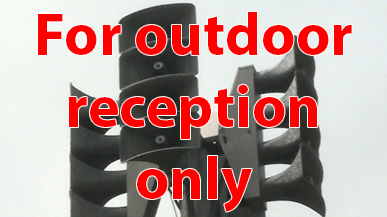
Photo of outdoor warning siren with superimposed text "For outdoor reception only"Earlier, I wrote a post titled, “Stop believing in tornado sirens.” I hoped it would help convince readers that the decades-old technology is not the best way to learn of severe weather threats.

Now, here’s a bit more about better alternatives.

Weather alert radios

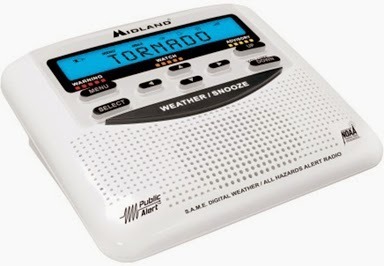
Photo of weather radioIn the earlier post, I mentioned weather alert radios. There are several manufacturers and models. What you want is one that supports Specific Area Message Encoding (SAME). It’s a system that allows weather radios to remain silent until a warning is issued for your own county. This means there’s never any reason to turn off the radio. One of the least expensive is the Midland WR120. I’ve seen it priced at under $35. It’s available at most Walgreens pharmacies, as well as other local retailers. There are plenty of other choices. Just do a search on Amazon or any other shopping website for “weather alert radio same.”

Smartphone apps

Logo for American Red Cross tornado appSmartphone apps are another option. They have the advantage of using the phone’s GPS to know where you are and alert you of warnings for that location, even when you’re away from home. Be sure to choose an app that make a loud enough noise to wake you.

I’ve tested the Storm Shield App from the E.W. Scripps Company. It’s available for iOS and Android.

Wireless emergency alerts logoBy the way, if you have a new enough smartphone, it probably supports Wireless Emergency Alerts (WEA), which means that even without installing an app, the phone will sound off when a tornado warning is issued for wherever you are. It depends on the device and the cell phone company. My old iPhone 4 did not support WEA, but the newer iPhone 4S does. Follow the link at the beginning of this paragraph to find out if your phone supports WEA.

I know of no other options that will wake you in the middle of the night. But during the daytime and evening when you’re still up, the following resources can be helpful:

Text messaging

Many local TV stations send subscribers text messages when the NWS issues weather warnings. Just visit the website of your favorite station to see what it offers.

Other websites also offer text messaging, some for free and some for a fee, including:

Not that if a storm destroys your nearest cell phone tower, that might keep you from getting text messages on time.

Local broadcast radio and television

If you know a watch has been issued, you can learn of warnings by keeping a radio or TV on and tuned to a local station. Most will automatically interrupt programming when the NWS issues a warning for their listening/viewing areas.

Social Media

Local broadcasters and the NWS often post news of weather warnings on Twitter and Facebook. Social media, however, should never be your primary source of warning information, because warnings might not appear promptly enough.

Know someone who could benefit from this information? Use the sharing buttons below to share it with your own social networks. Feel free to submit a comment if you have other suggestions for weather radios and/or other sources of severe weather information.

Stop believing in tornado sirens!

Photo of tornado siren

In support of Indiana’s Severe Weather Preparedness Week (March 16 – 22), I plan to post a series of articles on this blog. Some will be targeted at my readers who are members of the general public and others will be intended for trained SKYWARN storm spotters.

This first instalment in the series is for everyone; especially everyone who thinks tornado sirens will keep them safe from severe weather.

Tornado sirens are something of a tradition in the Midwest. For many of us, the very sound of a tornado siren creates an emotional response – which is why some NFL teams play recordings of tornado sirens during games. These sirens are so woven into our culture that many Midwesterners dangerously assume that if a tornado threatens their town/city/neighborhood, they’ll hear a tornado siren. Just as dangerously, many believe that if they don’t hear a siren, there’s no real danger.

In fact, very few communities have enough tornado sirens to protect all residents. And no sirens are intended to be heard indoors. So, if you rely solely on sirens to keep you safe, chances are very high that even if a tornado is bearing down on you and even if it has been spotted, warnings have been issued and sirens activated, you won’t know about it!

Just to give you an idea of how sporadic tornado sirens can be, the area of Allen County, Indiana is 660 square miles. According to the Allen County Office of Homeland Security, only 175 square miles are within range of tornado sirens (“within range” meaning the sirens can be heard by people who are outdoors). That means only 26.5 percent of Allen County’s geography is within range of a tornado siren!

There are other issues with tornado sirens, but I’ll omit them for now. The bottom line is this: Stop believing in tornado sirens. Find other ways to know if you and your family are in danger, even late at night when you’re all asleep. A good start is to buy a weather alert radio, put fresh batteries in it, and program it to sound off when warnings are issued for your county.

Read more about weather alert radios and other alternatives to tornado sirens.

If you think this blog post is helpful, use the buttons below to share it on your Facebook page, Twitter, etc. You might save someone’s life!

Guest blog: Valuable resources for weather historians

1957 weather map
Daily Weather Map from 1957

Guest post by Michael Lewis, KG4KJQ
National Weather Service, Northern Indiana

When I was the science and operations officer in Jackson, Ken. and as the meteorologist in charge in Hastings, Neb., I used to do all kinds of digging through the historic archives for “significant” weather events.

You might find this interesting and there may be others who would as well. This is a must have for every history buff.

U.S. Daily Weather Maps
Publication History

The U.S. Signal Office began publishing weather maps as the War Department Maps on Jan. 1, 1871. When the meteorological activities of the Signal Corps were transferred to the newly-created Weather Bureau in 1891, the title of the weather map changed to the Department of Agriculture Weather Map. In 1913, the title became simply Daily Weather Map. In 1969, the Weather Bureau began publishing a weekly compilation of daily maps with the title Daily Weather Maps (Weekly series).

These maps can be downloaded from the NOAA Central Library: http://www.lib.noaa.gov/collections/imgdocmaps/daily_weather_maps.html

To view/print the maps requires the installation of a free browser plug-in. http://www.caminova.net/en/downloads/download.aspx?id=1

Michael Lewis, KG4KJQ is warning coordination meteorologist at the northern Indiana forecast office of National Weather Service, Syracuse, Ind.