Storm Spotters as Advocates

If you’re a trained SKYWARN storm spotter, who in your family knows more than you about severe weather? How about in your neighborhood, place of employment or place of worship?

Unlike most of your family, friends and coworkers, you know that a tornado watch means that conditions are favorable for the development of tornadoes and a tornado warning means it’s time to take cover. You know that flooding kills more people in northern Indiana than do tornadoes. You know that most people cannot rely on tornado sirens to warn them of danger.

Chances are, in most (if not all) of your circles, you are the severe weather expert.

I’d like to propose, therefore, that you have more responsibility than observing and reporting severe weather. You should also be a weather safety advocate.

I wrote in a previous post that many residents of Joplin, Missouri initially ignored warnings of the tornado that would devastate part of their city. Compared to years past, the National Weather Service is able to issue more specific warnings earlier than ever before. But for too many people, these advances are wasted, because they don’t know how to react to the information. That’s where you come in.

Be an advocate. Advise your friends and family to buy weather alert radios. Help program the radios. Help them learn how to interpret and react to severe weather information. Make sure they know that a tornado warning means “take shelter,” not “go outdoors to look.” Teach them they’re not necessarily in the clear just because 10 minutes have passed without a tornado.

We can be the best possible weather spotters but if the people we’re trying to protect don’t know what to do, what’s the point?
“Warning Desensitization” Makes SKYWARN Spotters even more Important

As I wrote earlier, I attended a severe weather symposium March 2, the same day that southern Indiana got slammed by tornadoes. In this post, I’ll share a little more about that conference.
It was the 16th Annual Sever Weather Symposium, organized and hosted by The Ohio State University’s Meteorology Club. This was not storm spotter training or even advanced spotter training. But any spotter who is interested in learning more about severe weather would do well to attend future instances of this symposium.
I was particularly interested in a presentation by Gary Garnet, warning coordination meteorologist, National Weather Service Cleveland, Ohio weather forecast office. Garnet spoke on “Findings from the Joplin Tornado Assessment.” His presentation about the devastating tornado strike in Joplin, Missouri on May 22, 2011 did not focus on meteorology. Rather, he reported on a study he helped to conduct to assess “issues ranging from internal NWS warning operations to dissemination strategies to public warning response.” Garnet and other team members had conducted nearly 100 interviews in Joplin with tornado survivors, business people, media representatives as well as emergency management, NWS and local government officials. The team’s full report is available on the Web.

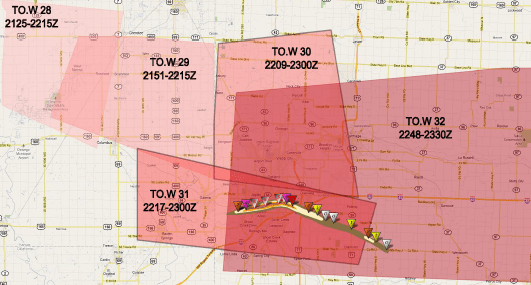
Tornado warnings issued before and during the Joplin tornado. Notice how some of the warning polygons overlap. Graphic courtesy NWS.
Garnet reported that due to warning desensitization, most Joplin residents did not take immediate action when they learned of the NWS tornado warning. Instead, most sought additional information, including going outside to look for the storm, eating away at the 21 minutes between the warning and the beginning of EF-4 tornado damage.

Garnet said “non-routine triggers” are what eventually prompted citizens to take action to protect themselves. For example, Joplin officials broke from their normal practice and sounded tornado sirens more than once. Broadcasters began imploring listeners to “take cover now,” something listeners were not accustomed to hearing.
In some ways, the weather service’s relatively new practice of basing warning areas on storm movement, rather than county lines, adds to the problem. Making warning areas more specific is a good idea but NOAA weather radio still alerts entire counties and many (if not most) tornado siren systems lack the ability to selectively activate sirens. In addition, subsequent warning polygons often overlap each other, confusing citizens.
So, what does all this have to do with ham radio? To me, it reinforces the importance of live reports from trained spotters. The earlier a spotter makes a report, the earlier NWS can issue a warning and the more time citizens have to decide whether they are at risk. Also, when a ham sees a tornado and reports it via radio, a lot of people hear it: other hams, NWS meteorologists, broadcasters and members of the general public who listen to spotter nets on their scanners. Such reports can provide the non-routine triggers that get people to take cover.