7 ways to report severe weather to NWS without ham radio

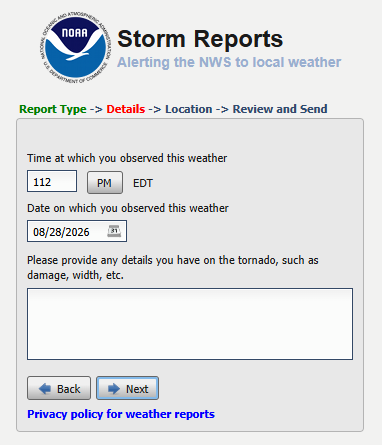
A screen shot of an NWS web form for reporting severe weather.

When the National Weather Service (NWS) started its Skywarn program in the 1960s, the first participants were licensed amateur (ham) radio operators. While many ham radio operators remain active in the program, the Skywarn storm spotters of today have many ways other than ham radio to send their reports. This article covers some of those communication channels for the benefit of spotters who don’t have ham radio licenses and for hams who need to send reports when their local on-air Skywarn networks are not active.

Phone calls

When a Weather Bureau meteorologist started the first ham radio Skywarn network after the Palm Sunday tornadoes of 1965, few people had car phones. Now, approximately 97% of the US population carries or owns a cell phone of some kind, according to data from the Pew Research Center. To report a tornado, funnel cloud, wind damage, etc. directly to an NWS weather forecast office (WFO), a trained storm spotter need only dial that office. Most WFOs have set aside a phone line for the sole purpose of receiving spotter reports.

A phone call gets attention in the WFO faster than most other reporting methods, so dialing the WFO is probably the best choice for the most dangerous sightings, like funnel clouds and tornadoes.

To keep people from using spotter phone numbers for other purposes, WFOs do not usually make them available on the web or other public communications. They usually provide special phone numbers during local storm spotter training classes. If you’ve taken the spotter course and misplaced the number, contact your local WFO now (via a number on the WFO’s website), tell them when you took the Skywarn training, ask for the number, and store it in your phone.

Alternatively, if you are a member of Spotter Network (see below), that organization’s “Submit Report” web page usually provides the spotter phone number for the appropriate WFO, based on your location.

NWS web forms

Any spotter who has access to the web (including via a mobile phone) may enter a report on a web form for any WFO. The URL is the same, no matter where you are: https://inws.ncep.noaa.gov/report/.

Spotter Network

Spotter Network, Inc. is a non-profit organization that is dedicated to bringing storm spotters, storm chasers, coordinators and public servants together in a seamless network of information. Storm spotters who join the organization and complete its online training may submit their reports via a form on the Spotter Network website. When the website determines the spotter’s location, it displays the location and phone number of the appropriate NWS office. That gives the member the option of calling the WFO for more urgent reports or completing the form. Spotter Network forwards data from its web form directly to the NWS.

X.com (Twitter)

Most WFOs have accounts on the social network formerly known as Twitter. Tagging your local WFO in a tweet is a great way to send a photo to supplement your report. It’s important to remember, however, that a tweet might not get noticed immediately, so a phone call is better for something like a funnel cloud or tornado. To find the correct X.com username to tag, search X.com for “NWS (office name).” For example, a search for “NWS Northern Indiana” reveals that the tag you should include in a tweet for that office is “@NWSIWX.” Don’t assume, however, that all WFOs use their three-letter IDs in their X account names. The Indianapolis office, for example, uses “@NWSIndianapolis,” not “@NWSIND.”

Facebook

Facebook is another way to send photos of severe weather or its impacts. Some NWS meteorologists have told me, however, that during severe weather, their offices don’t always have time to check Facebook often, making it a poor way to report a tornado. Facebook is well-suited, however, for sending photos of storm damage after a storm passes. Such photos can help WFOs decide where to send survey teams the next day. Search Facebook for the page that your local WFO operates. When you get there, post your report as a comment under an existing post on the page.

mPING

Meteorological Phenomena Identification Near the Ground (mPING) is a project to collect weather information from the public through their smart phones or other mobile devices. The free mPING iOS and Android mobile apps were developed through a partnership between the National Severe Storms Laboratory, The University of Oklahoma and the Cooperative Institute for Mesoscale Meteorological Studies. Anyone may download the apps from the Apple App Store or Google Play. Among the weather phenomena that mPING users may report are tornadoes, hail, storm damage and winter weather impacts. The reports use the mobile device’s GPS unit to include the exact location in the report and to route the report to the appropriate WFO. Some other apps, like RadarScope incorporate mPING so users can send reports without changing apps.

Email

Every WFO has a general email address. Meteorologists eventually see messages sent to those addresses. It’s unlikely, however, that such an email message will receive immediate attention, especially during severe weather. This makes email better for after-the-fact damage reports than for tornado reports. To find a WFO’s general email address, scroll to the bottom of the WFO’s web page (e.g. www.weather.gov/ind) and click on the link that reads, “Comments? Questions? Please Contact Us.”

Indiana weather alerts via social media

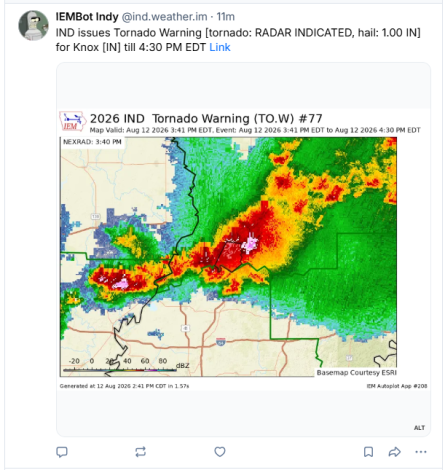
A screen shot of a tornado warning for Knox County, Indiana as it appeared on Bluesky after IEMbot automatically posted it.

I have for many years recommended having multiple sources of severe weather alerts and I have previously blogged about the best sources. Although social media is not the best way to receive information about impending severe weather, it’s one of many tools that can improve your awareness.

When I’m available, I share information such as mesoscale discussions, watches, etc. on various social media channels. I’m rarely available, however, to share National Weather Service (NWS) warnings in a timely manner. Fortunately, such warnings get posted automatcially to certain social media platforms by bots created and operated by Iowa State University’s Iowa Environmental Mesonet.

To find them, you must know which NWS weather forecast office (WFO) provides warnings for your county and you need to know the social media accounts in which that WFO’s alerts get automatically posted.

Start by finding your county on the list below to learn which WFO serves that county. Beneath that list are lists of accounts to follow on each of severel differnet social media platforms.

Indiana CountyWFO
AdamsNorthern Indiana (IWX)
AllenNorthern Indiana (IWX)
BartholomewIndianapolis (IND)
BentonChicago (LOT)
BlackfordNorthern Indiana (IWX)
BooneIndianapolis (IND)
BrownIndianapolis (IND)
CarrollIndianapolis (IND)
CassNorthern Indiana (IWX)
ClarkLouisville (LMK)
ClayIndianapolis (IND)
ClintonIndianapolis (IND)
CrawfordLouisville (LMK)
DaviessIndianapolis (IND)
DearbornWilmington, OH (ILN)
DecaturIndianapolis (IND)
DeKalbNorthern Indiana (IWX)
DelawareIndianapolis (IND)
DuboisLouisville (LMK)
ElkhartNorthern Indiana (IWX)
FayetteWilmington, OH (ILN)
FloydLouisville (LMK)
FountainIndianapolis (IND)
FranklinWilmington, OH (ILN)
FultonNorthern Indiana (IWX)
GibsonPaducah, KY (PAH)
GrantNorthern Indiana (IWX)
GreeneIndianapolis (IND)
HamiltonIndianapolis (IND)
HancockIndianapolis (IND)
HarrisonLouisville (LMK)
HendricksIndianapolis (IND)
HenryIndianapolis (IND)
HowardIndianapolis (IND)
HuntingtonNorthern Indiana (IWX)
JacksonIndianapolis (IND)
JasperChicago (LOT)
JayNorthern Indiana (IWX)
JeffersonLouisville (LMK)
JenningsIndianapolis (IND)
JohnsonIndianapolis (IND)
KnoxIndianapolis (IND)
KosciuskoNorthern Indiana (IWX)
LaGrangeNorthern Indiana (IWX)
LakeChicago (LOT)
LaPorteNorthern Indiana (IWX)
LawrenceIndianapolis (IND)
MadisonIndianapolis (IND)
MarionIndianapolis (IND)
MarshallNorthern Indiana (IWX)
MartinIndianapolis (IND)
MiamiNorthern Indiana (IWX)
MonroeIndianapolis (IND)
MontgomeryIndianapolis (IND)
MorganIndianapolis (IND)
NewtonChicago (LOT)
NobleNorthern Indiana (IWX)
OhioWilmington, OH (ILN)
OrangeLouisville (LMK)
OwenIndianapolis (IND)
ParkeIndianapolis (IND)
PerryLouisville (LMK)
PikePaducah, KY (PAH)
PorterChicago (LOT)
PoseyPaducah, KY (PAH)
PulaskiNorthern Indiana (IWX)
PutnamIndianapolis (IND)
RandolphIndianapolis (IND)
RipleyWilmington, OH (ILN)
RushIndianapolis (IND)
St. JosephNorthern Indiana (IWX)
ScottLouisville (LMK)
ShelbyIndianapolis (IND)
SpencerPaducah, KY (PAH)
StarkeNorthern Indiana (IWX)
SteubenNorthern Indiana (IWX)
SullivanIndianapolis (IND)
SwitzerlandWilmington, OH (ILN)
TippecanoeIndianapolis (IND)
TiptonIndianapolis (IND)
UnionWilmington, OH (ILN)
VanderburghPaducah, KY (PAH)
VermillionIndianapolis (IND)
VigoIndianapolis (IND)
WabashNorthern Indiana (IWX)
WarrenIndianapolis (IND)
WarrickPaducah, KY (PAH)
WashingtonLouisville (LMK)
WayneWilmington, OH (ILN)
WellsNorthern Indiana (IWX)
WhiteNorthern Indiana (IWX)
WhitleyNorthern Indiana (IWX)

Bluesky

If you use the social media platform Bluesky, follow the IEMbot account below that’s associated with your WFO from the list above:

WFOBluesky IEMbot account
Chicago@lot.weather.im
Indianapolis@ind.weather.im
Louisville@lmk.weather.im
Northern Indiana@iwx.weather.im
Paducah@pah.weather.im
Wilmington, Ohio@iln.weather.im

X.com (formerly Twitter)

On X.com, you can follow two different accounts for each WFO. Posts in each WFO’s official account are created manually by NWS meteorologists as they have time. Posts in the IEMbot account are created automatically from the alerts that the WFO creates.

WFOX.com official accountX.com IEMbot account
Chicago@NWSChicago@iembot_lot
Indianapolis@NWSIndianapolis@iembot_ind
Louisville@NWSLouisville@iembot_lmk
Northern Indiana@NWSIWX@iembot_iwx
Paducah@NWSPaducah@iembot_pah
Wilmington, Ohio@NWSILN@iembot_iln

Mastodon

Iowa Environmental Mesonet does not appear to have created IEMbot accounts on Mastodon, but my Mastodon account automatically posts IEMbot data for every Indiana county. You may follow it at @jayfarlow@wx.social.

Facebook

I”m not aware of any Facebook account that automatically posts all the warnings of WFOs that serve Indiana. In addition, Facebook’s algorithm can create significant delays. Each WFO has it’s own Facebook account (below) to which meteorologists manually post valuable information, so these are nonetheless worth following.

WFOFacebook page
Chicagohttps://www.facebook.com/NWSChicago
Indianapolishttps://www.facebook.com/NWSIndianapolis
Louisvillehttps://www.facebook.com/NWSLouisville/
Northern Indianahttps://www.facebook.com/NWSNorthernIndiana/
Paducahhttps://www.facebook.com/NWSPaducah/
Wilmington, Ohiohttps://www.facebook.com/NWSWilmingtonOH/

Web

Every WFO also has its own web page that’s worth bookmarking and visiting on a regular basis.

Programming the Baofeng DM-32UV handheld DMR radio

In 2025, Fujian Baofeng Electronics Co., Ltd. invited me to write a series of posts for the blog on the company’s website about how to program its DM-32UV handheld DMR radio. I wrote seven posts, links to which appear below.