Category Archives: Disasters

Advice for worried families after hurricanes and other disasters

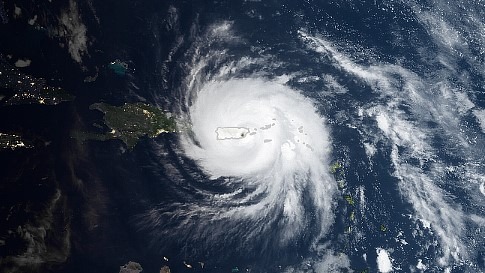
NASA satellite image of Hurricane Maria over Puerto Rico

I can’t imagine what it must be like to have a loved one on an island that’s struck by a major hurricane. The worry must be terrible.

Because I’m an amateur (ham) radio operator, I have received requests from strangers who are desperate for help getting welfare inquiries through to places like Dominica and Puerto Rico after Hurricane Maria struck.

Based on my years of experience in emergency response (including disaster response) and emergency communications. I have some words for such people that I hope will be helpful.

First, it’s important to remember that absence of communication does not mean that your loved one has been harmed. In most cases it means only that the disaster’s survivors temporarily have no way to tell you that they’re OK. So, as hard as it might be, maintain hope.

In the absence of other means of communication, one of the few things a distant family can do is search the Red Cross’ “Safe and Well” website.

Second, in the absence of other means of communication, one of the few things a distant family can do is search the Red Cross’ “Safe and Well” website. For a number of reasons, that’s an imperfect answer, but it’s often the only option. The site does not allow families to send inquiries into affected areas. It does, however, allow them to see if a survivor has added himself or herself to the “safe and well” list. Of course, survivors can do so only if a.) they have access to the internet and b.) they know about the website.

In many cases, ham radio operators like myself are present in disaster-struck areas. It’s logical to believe that a ham outside the disaster area can help people learn if their loved ones are safe. There are some important things, however, that such people might not realize.

Any hams who lived through the disaster (e.g. hurricane landfall) must first deal with the immediate needs of their own households before they can be of help to others. This includes obtaining necessary medical care, shelter, food, etc. Depending on the intensity of the disaster, this could take considerable time.

Likewise, a hurricane can destroy the external antennas a ham needs to communicate with the outside world. Assuming the ham has the necessary materials, he or she can build a temporary antenna, but this can also take time.

Ham radio equipment requires electricity. As I write this, the entire island of Puerto Rico is without commercial power. Except for solar or wind-powered systems, the only electricity available is coming from privately owned generators (typically fueled by gasoline). Any ham who lives on the island and doesn’t have such a power source is off the air (or will be, after batteries die). And hams who have generators can operate their radios only as long as the generators’ fuel lasts. Finding fuel could be a challenge, with roadways blocked by trees and gasoline stations lacking power for pumps.

Now, let’s assume for a moment that there are hams on Puerto Rico whose homes and antennas survived the storm, whose families need no assistance and who have plenty of emergency electricity. It still might not be possible for these hams to receive inquiries from worried families on the U.S. mainland. Why? I’m sorry to say, that they might well have more important things to do with their radios.

In such disasters, ham radio operators are often busy for a time passing emergency and other urgent messages. An ambulance is needed here. A rescue team is needed there. Supplies are needed at that shelter. Such messages can completely occupy local hams for days after a disaster. They have no choice but to reject incoming welfare inquiries until all the emergency and urgent communication is handled.

Next, ham radio channels become busy with outgoing welfare messages. That’s what I was hearing on the radio today. Hams I heard in Puerto Rico were completely tied up sending messages off the island for their neighbors. It was one message after another, without a break for inquiries to flow to the island.

Eventually, the local hams will catch up and be able to accept incoming messages. Just as eventually, telephone and internet service will become available to survivors.

In the interim, difficult as it is, worried families need patience and hope.
Palm Sunday tornado tweets a must read for weather, history buffs

Anyone interested in severe weather, history, or both will greatly appreciate a series of posts that the National Weather Service northern Indiana weather forecast office (WFO) published on the micro-blogging site Twitter yesterday.

And the WFO’s staff should be commended for excellent work gathering a great deal of historical information about the April 11, 1965 Palm Sunday tornado outbreak and for presenting it in such a compelling way.

The WFO prepared more than 100 tweets, many with images of actual text products issued via teletype the day of the outbreak. Other tweets contained Google maps with tornado tracks marked on them and photos of the tornadoes taken by citizens and photojournalists.

To add to the drama, the WFO scheduled each tweet to appear on Twitter at times coincident with the actual times of day that the events occurred. Genius.

The WFO’s series of tweets gives viewers a real sense of how different severe weather forecasting, detection and warnings were 50 years ago. For example, one thing that struck me was the Fort Wayne Weather Bureau office relaying to local broadcast media via teletype word of tornadoes in the Lafayette area. These days, because of better detection and communication technology, you rarely see WFOs issuing text products regarding tornadoes that distant.

If you missed the live tweets yesterday, you’re in luck, because they’re still visible on the Twitter website, even to people who do not have Twitter accounts. Just follow this link. When you get there, scroll down to a point near the bottom of the page to the tweet that reads, “We are beginning the live tweet of the events of 4/11/65, the Palm Sunday Tornado Outbreak,” and then read your way up from there.

I highly recommend it.


Indiana & Michigan Power gets post-storm communication right

Photo of crews replacing utility poles
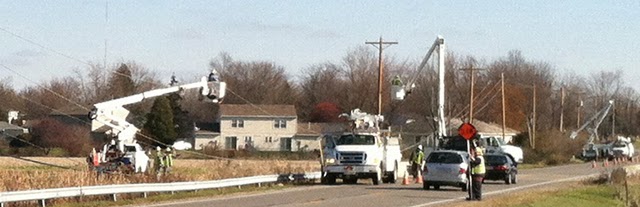
I&M crews replace several poles broken by the Nov. 17 severe thunderstorm. (Jay Farlow photo)

I’m really impressed with the communications staff at Indiana and Michigan Power, the AEP branch that sells electricity in Fort Wayne, Indiana, where I live. Here’s why:

After the severe thunderstorms and tornadoes of Nov. 17 rolled through, thousands of I&M customers were without power, including our neighborhood. We live half a mile north of a stretch of road where the wind below down at least seven utility poles in a row.

I&M very effectively used its web site to provide regular updates on the situation. There, I could see estimates of when power would be restored in various locations, or if such estimates were not yet available, estimates of when the estimates would be available! The Web page also provided an explanation of the seriousness of the problem (e.g. the number of utility poles blown down) and information about the utility’s response, including the number of staff members and contractors who were working on service restoration.

I&M published on the same page the date and time of the current update, and the date and time to expect a new update. They updated the page frequently, even outside of business hours.

For me, however, the icing on the cake is this text, which appeared on the page today:

Additional Information
We will be flying Transmission lines in central & western Indiana to inspect the lines for vegetation resulting from the storm. I&M customers may see the helicopter in the Muncie and Fort Wayne areas. Tail Number N105JD Black with Grey Stripes in color.

Look at that! There’s no need for I&M customers who read that Web page to worry when the inspection helicopter flies by. Readers know exactly what to expect, right down to the helicopter’s tail number!

Any company, agency or organization that’s involved in any kind of public service and/or emergency response would do well to pay attention to how effectively I&M communicates information about major power outages. Clearly, I&M understands the value of keeping the public as informed as possible on a very regular basis.