Tag Archives: storm spotter

Demand strong for volunteer storm spotter class

Library expands meeting space to accommodate weather enthusiasts

Strong pre-registrations for a free class on how to recognize and report severe weather phenomena led a local organization to add meeting space to accommodate more people. The Allen County branch of the national Amateur Radio Emergency Service® (ARES) will host the class at the Allen County Public Library, 900 Library Plaza, Fort Wayne, Thursday, Feb. 21 at 6:30 p.m. By Feb. 12, only nine seats were still available, so the library agreed to expand the meeting space, adding 30 seats.

Scheduled speakers include meteorologists from ABC21, Fort Wayne’s NBC, Fox 55 and WANE 15. Allen County Office of Homeland Security director Bernie Beier and Consolidated Communications Partnership deputy director John Chavez also plan to speak.

The class is free and open to the general public, but because fewer than 40 seats are still available, Allen County ARES requests all who plan to attend, to register in advance at https://www.eventbrite.com/e/allen-county-storm-spotter-education-tickets-54685721465

“This two-hour class will provide attendees the knowledge they need to help protect their communities from severe weather like tornadoes,” said Jim Moehring, emergency coordinator (team leader), Allen County ARES. “Although we are a ham radio organization, people need not be hams to be storm spotters, so we welcome anyone who is interested in weather.”

Moehring said the “ground truth” that volunteer spotters provide is essential to the process through which the National Weather Service (NWS) issues storm warnings. He pointed out that this remains true despite advances in weather radar, because the beam from the NWS radar site near North Webster is 2,500 feet or more above the ground by the time it reaches Allen County.

Traditionally, meteorologists from the NWS Northern Indiana office near North Webster have presented spotter training every spring in Fort Wayne. Changes in the office’s responsibilities, however, led it to change its training schedule. As a result, NWS meteorologists won’t be in Fort Wayne until autumn of 2019 and then not again until spring of 2021.

“We wanted to assure that our members and members of the general public have a chance to receive storm spotter education before this spring’s severe weather season,” Moehring said. “We therefore decided to devote our group’s February meeting to a spotter class and to invite everyone to attend. Because NWS meteorologists aren’t available, we’re thrilled that four TV stations in Fort Wayne are sending meteorologists to help teach the weather-related material.”

A complete list of speakers and their topics follows:

  • Jim Moehring, Allen County ARES emergency coordinator (team leader): Introduction to the NWS SKYWARN program and the importance of volunteer storm spotters.
  • Jay Farlow, Allen County ARES assistant emergency coordinator for SKYWARN: How storm warnings are issued and distributed. Also, storm spotter reporting methods and best practices.
  • Charles Ward, experienced storm spotter: Best practices to remain safe while storm spotting.
  • Bernie Beier, Allen County Office of Homeland Security director: The role of the Allen County Office of Homeland Security with regard to severe weather.
  • John Chavez, Consolidated Communications Partnership deputy director: The role of the Consolidated Communication Partnership (911/dispatch) in severe weather events.
  • Caleb Saylor, Fox 55 weekend meteorologist: Thunderstorm basics, including how storms form and become severe.
  • Caleb Chevalier, ABC21 weekend morning meteorologist: Types of thunderstorms, including those most likely to create tornadoes. Also, radar apps and interpretation.
  • Jon Wilson, Fort Wayne’s NBC weekend meteorologist: Thunderstorm hazards, including straight-line winds, large hail, flash flooding and tornadoes.
  • Nicholas Ferreri, WANE 15 chief meteorologist: Cloud identification, including distinguishing scary-looking but benign weather from true threats that spotters should report.

About the Amateur Radio Emergency Service

The Amateur Radio Emergency Service® (ARES) is a program of ARRL, the national association for amateur radio®. ARES establishes teams of volunteer, licensed amateur (ham) radio operators in counties throughout the country, each of which is led by an emergency coordinator. These volunteer teams train and practice to provide communication services to their communities in the event of a disaster. Through a memorandum of understanding signed by ARRL and the National Weather Service (NWS), ARES volunteers also commit to communicating weather information that assists the NWS in the creation of weather warnings. In addition, ARES volunteers practice their communication skills by providing two-way radio communications at public events, such as marathons, walk-a-thons, etc. More information about ARES is available on the ARRL website at http://www.arrl.org/ares.

How new friends changed my attitude about storm chasers

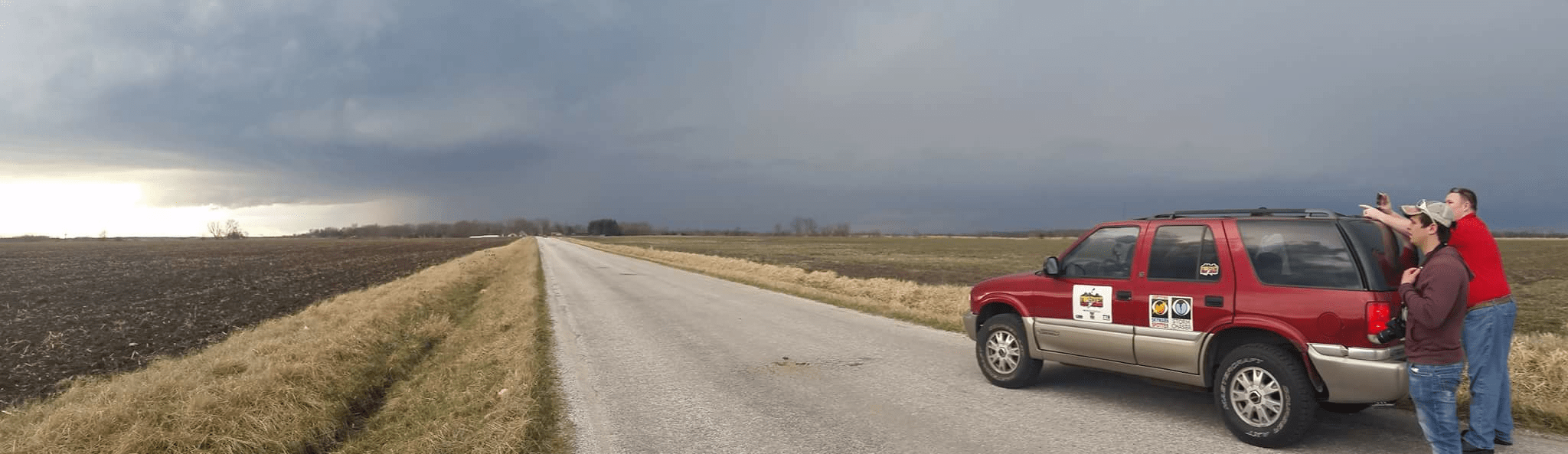
Storm chasers on a storm
Photo by Michael Enfield, used with permission

For some time, I’ve looked at amateur storm chasers with some disdain. I believed that too many were putting themselves into too much danger, just to see, photograph and/or video record tornados. I doubted that many chasers were truly motivated by improving public safety and even fewer were doing real science, no matter what they said. I was concerned that many chasers set poor examples for the general public and that their “antics” encouraged lesser informed people to take uneducated and unwise risks.

I’ve been a SKYWARN storm spotter for more than a quarter century. When talking to friends, family members and even journalists about my volunteer service to the National Weather Service (NWS), I was careful to make sure they understood that I’m not a chaser, like the people they’ve seen on TV or on the Web. My ultimate goal, I’d explain, isn’t to see tornadoes, it’s to help protect my community from possible storms by staying close to home and relaying valuable information to the NWS.

So it was with some trepidation that I attended an event in November, 2015 called INChaserCon, a one-day convention in the Indianapolis area for storm chasers. I’m glad I went. Some of the people I met there changed my thinking. They are admittedly driven by a desire to see tornadoes. But my experience with them demonstrated that they’re also very passionate about getting reports to the NWS.

After the chasers learned that I have access to NWSChat – a private, internet-based text chatroom run by the NWS – they invited me to join them on Zello, a smartphone app with which they communicate with each other—so I could relay their reports to the NWS via NWSChat.

That’s exactly what happened during the August, 2016 tornado outbreak in Indiana and Ohio. As a tornadic storm moved east from Kokomo into the county warning area of my local NWS office, storm chasers John Tinney, Eric Lawson and David Buell reported wall clouds, funnel clouds, etc. via Zello. I relayed those reports via NWSChat.

Then, a storm over my own home in Fort Wayne, Indiana received a tornado warning. Storm chaser Michael Enfield immediately headed toward that storm. Via Zello, he promptly reported a wall cloud, then funnel clouds and then a tornado for me to relay via NWSChat. The NWS survey report recorded the time of the tornado’s initial touchdown as 5:27 p.m. – the same time as Enfield’s report, confirming that he saw and reported the tornado when it first touched down. That storm eventually did EF-3 damage to a rural part of Allen County, Indiana.

Throughout the event, any time the chasers had something to report, if I wasn’t immediately available on Zello, they’d keep trying until I acknowledged their reports. Getting reports through to the NWS was clearly very important to them. By the end of the event, I had typed 50 reports into NWSchat. All but about 15 of those came from storm chasers on Zello. The rest came from storm spotters via ham radio.

By aggressively chasing storms, my new friends put themselves in positions to immediately report weather that was not near any traditional SKYWARN spotters at the time. By religiously reporting, they played significant roles in protecting people in the paths of the storms.

A Facebook post by Lawson sums up pretty well how this particular group of storm chasers sees things:

“I noticed a developing supercell heading towards Kokomo was looking really strong and rushed out the door. By the time I was on interstate 69 southbound the strong EF3 was already in progress and heading towards the town in which I have spent many days of my youth, and is home to many great friends and their families. Hearing reports of the devastation in progress on the radio made my heart sink. I was rushing south in horror wondering if anyone I knew had been hurt. This is the moment that things really changed for me, I felt less excited about seeing tornadoes, and much more concerned with providing accurate information to keep people informed.”

I have no doubt there are other storm chasers out there who rarely report their observations to the NWS. There are likely some that don’t care about anything but the excitement of seeing a tornado.

But I’m convinced that the storm chasers I know are not among these. They’ve changed my attitude about chasers.

Making storm spotter reports while traveling

U.S. map showing county warning areas of each National Weather Service weather forecast office
County warning areas of each National Weather Service weather forecast office (NWS image).

During the Central Indiana Severe Weather Symposium, March 5, 2016 in Indianapolis, an attendee asked how spotters, particularly those who are hams, can report to appropriate National Weather Service (NWS) weather forecast offices (WFO) while traveling away from home.

There are several good answers to that question. It helps to know that each WFO has its own area of responsibility, which the NWS calls a county warning area (CWA). It is defined by a list of counties (or parishes) for which that WFO issues weather warnings. Generally speaking, every county in a given WFO’s CWA is closer to that WFO’s doppler radar station that to any other WFO’s radar. This is why CWAs often cross state lines.

If you want to make a spotter report while traveling, therefore, you need to know two things:

  1. Which WFO’s CWA you’re in.
  2. How to contact that WFO.

SpotterNetwork.org

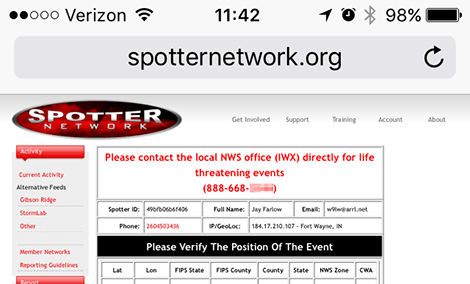
SpotterNetwork.org's reporting page displays the ID and phone number of the appropriate NWS office to members who are logged in and using a location-reporting app.
SpotterNetwork.org’s reporting page displays the ID and phone number of the appropriate NWS office to members who are logged in and using a location-reporting app.

By far, the simplest way to accomplish both steps above is to register with SpotterNetwork.org and install compatible position-reporting software on a smartphone or similar GPS- and mobile- data-equipped mobile device.

I use WDT’s RadarScope app on my iPhone. According the the SpotterNetwork.org website, Android users have several additional choices, including ChaserLocation, PYKL3 Radar and Radar Alive!

In my case, RadarScope (when properly configured and activated) continually transmits my iPhone’s GPS coordinates to SpotterNetwork.org servers. If I need to make a report, I just log into my account on SpotterNetwork.org’s home page with any Web browser (including the one on my phone), and then select the “Submit Severe Report” link.

Because SpotterNetwork.org knows where I am, it displays at the top of the reporting page the three-letter identifier of the WFO whose CWA I’m in and the best telephone number through which to make a report to that WFO (in most cases, it’s the “bat phone” number that’s reserved for spotters). Then, I can call that number (the best choice for life-threatening situations, like a tornado) or enter my report into the SpotterNetwork.org website and let SpotterNetwork.org send it to the proper WFO electronically.

Weather.gov

The watch-warning-advisory map on the NWS home page allows viewers to find the NWS office for any location by clicking that location on the map.

You can determine the appropriate WFO for any location in the country by using the NWS home page, www.weather.gov. Just click anywhere on the U.S. map. Near the top of the Web page that appears, you’ll see a headline that indicates the name of the WFO in whose CWA you clicked. If you scroll to the bottom of that page, you’ll find a phone number for that WFO. Unfortunately, it’s the main office phone number, not the special spotter report number. Depending on the time of day and how the WFO set up its phone system, you might not be able to reach a WFO staff member on that number.

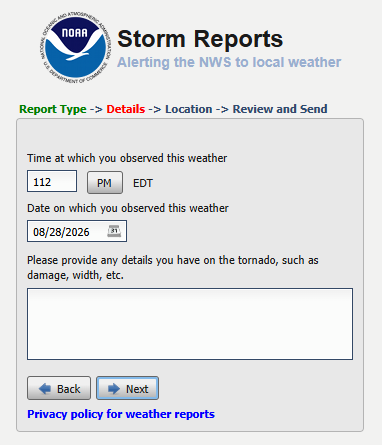
Once you get on the appropriate WFO’s website, however, you should be able to easily find a weather reporting Web form, the WFO’s Twitter handle or even a link to the WFO’s Facebook page, all of which provide alternatives to calling.

If you don’t have mobile Internet, you can use weather.gov before your trip to make your own list of the WFOs through whose CWAs your route will take you.

911

You can call 911 to report life-threatening weather. The phone system will automatically route your call to an appropriate public safety answering point (PSAP) for your location, where a staff member will know how to relay your report to the appropriate WFO.

Disadvantages of this method include:

  • During times of severe weather, PSAPs are often too busy taking incoming calls to relay any information to the NWS.
  • The PSAP call taker might not appreciate being told about one-inch-diameter hail, even though the WFO would want to know about it.

Amateur (ham) radio

Learning how to make spotter reports via ham radio while out of your normal area can be challenging. You’ll have to determine which frequency is used by hams in your current location. Even if you’re successful, you might not be able to reach the WFO or someone who can relay your report to the WFO.

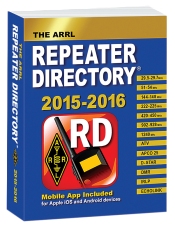
In most communities, hams conduct weather-related communications on a repeater system.  Ways to learn what repeaters exist in any location include the American Radio Relay League’s (ARRL) printed “Repeater Directory,” the website and apps of the ARRL-endorsed www.rfinder.net and the independent RepeaterBook.com website.

Some listings in the ARRL directory and on repeaterbook.com indicate that a listed repeater is used for weather-related activities. When that indication is available, such repeaters are good places for ham-radio-equipped spotters to start. You might, however, need to try multiple repeaters within range to find one on which a SKYWARN net operates. It’s therefore a good idea to communicate with local hams as you enter an area, so that you’ll already know about local on-air SKYWARN practices before you need to call in a report. This is especially important, because the local SKYWARN net might not permit participation by outsiders.

Call your home WFO

As a last resort, you can always use the “bat phone” number for your home WFO. Be sure to tell the call taker early in the call that you’re outside their CWA and that you’re requesting them to relay your report to the appropriate WFO.

Where thunderstorms go to die

SKYWARN storm spotters and future spotters prepare for training Feb. 16, 2016 at the Public Safety Academy of Northeast Indiana, Fort Wayne

The husband-and-wife team of Amos and Megan Dodson, both meteorologists at the northern Indiana office of the National Weather Service (NWS), conducted the annual SKYWARN storm spotter training Feb. 16 at the Public Safety Academy of Northeast Indiana.

The content of the training didn’t change much from last year’s presentation. It focused on the differences between truly threatening weather phenomena and scary-looking, but harmless (and unreportable) conditions.

Here are some highlights:

  • Spotter reports add credibility. When the NWS issues a warning that includes a reference to a spotter report, members of the general public are more likely to take action than when the warning does not include a spotter reference.
  • Don’t wait for activation. Although our NWS office issues hazardous weather outlooks that indicate whether spotter activation is likely, the office does not “activate” or “deploy” spotters. It welcomes spotters to make reports anytime they see anything reportable.
  • Clouds with ragged edges aren’t spinning. Scary-looking SCUD clouds that are shaped like funnel clouds generate a lot of well-intended but false reports from untrained observers. True funnel clouds and tornadoes spin, giving them sharper, smoother edges.
  • When unsure, send a photo. NWS encourages spotters who see something that might be reportable (like a possible wall cloud or funnel cloud), to photograph it and send the photo via Twitter (@NWSIWX) or the NWS office’s Facebook page. The office monitors both social networks closely during severe weather events.
  • T.E.L. NWS. When spotters make reports, they should provide the Time of the observation, a description of the Event, and the Location of the event. The actual time of day is more valuable than “right now” or “two minutes ago.” And because the local NWS office does not issue spotter credentials, formatting reports in that specific order is one way spotters can demonstrate they attended the training.
  • Thunderstorms come here to die! Spotters provide a valuable service to their communities even if they don’t see anything reportable. And climatology data shows that spotters in Indiana are about half as likely to see something as are spotters in Illinois. Megan Dodson shared that this leads meteorologists to joke that Indiana is where thunderstorms come to die.

Mysteriously, far fewer people attended the training than registered for it, even though weather did not hinder travel that night. Those in attendance, however, included TV meteorologist Hannah Strong, who indicated that the presentation included information not provided in meteorology school.

People who missed the training can get via the Web most of the information they need to be effective spotters. Two options include

Indiana man’s car shows unusual commitment to storm spotting

Dunkirk, Ind. volunteer SKYWARN storm spotter Gary Wesley paid a sign company to decorate his primary vehicle with weather-related graphics to promote his avocation.
Dunkirk volunteer storm spotter Gary Wesley paid a sign company to decorate his primary vehicle with weather-related graphics to promote his avocation.

An east-central Indiana man has gone to unusual lengths to promote the National Weather Service’s SKYWARN program, which recruits and trains volunteer storm spotters. Gary Wesley, Dunkirk, bought a decommissioned, 2005 Chevrolet Impala police car and paid a sign company $2,000 to design, create and wrap the vehicle with weather-related graphics. Wesley also installed an amber light bar and ham radio antennas.

Having gotten involved in storm spotting as a teen, Wesley was disappointed by the level of interest he discovered when he settled in Dunkirk after a medical retirement from a military career that included time as a recruiter for the Indiana Army National Guard. His work as a recruiter gave him an idea to promote the SKYWARN program.

“We had a Humvee that we called, ‘The Super Hummer,’ that was all decked out with images on it to help with recruiting at events,” Wesley said.

He decided to create his own rolling billboard for storm spotting.

“I figured, with my passion for being involved in storm spotting and volunteer work, it would just be an easy way to promote it,” Wesley explained. He believed that if nothing else, people who saw the car would ask questions about it, giving him a chance to talk about storm spotting.

Wesley uses the car for more than storm spotting. It’s one of two cars in the family (his wife drives a Jeep) and his primary form of transportation.

“The only thing that I’m hoping for … is to be able to increase the number of spotters.”

He says the car has attracted attention and provided a few opportunities to explain storm spotting to strangers. But he’s gotten a few negative reactions, too.

Dunkirk, Ind. volunteer SKYWARN storm spotter Gary Wesley paid a sign company to decorate his primary vehicle with weather-related graphics to promote his avocation.“Everyone at the VA hospital thinks it’s nuts,” Wesley commented. “There has been a few people,” Wesley continued, “that, when they see the car, just because of the light bar and antennas … feel that I’m trying to impersonate a police officer.” After he explained the car and storm spotting, he said, the same people expressed their continued (misguided) beliefs that storm spotters are not needed, because of radar and the Internet.

And his wife? Her first reaction, Wesley said, was “I am not driving something like that around.” Unfortunately for her, it’s sometimes necessary for the two to trade cars, for example, when Wesley needs to pick up something that won’t fit in the Impala. Her attitude softened with time and Wesley says she has no problem with it anymore, although she still thinks it’s “kind of loud and obnoxious-looking.”

Wesley does not deny that he intended for the car to attract attention, but he said he doesn’t want that attention for himself.

“The only thing that I’m hoping for with this vehicle,” Wesley said, “is to be able to increase the number of spotters that are out there and to make people more aware of weather issues.”

Has technology led people to believe storm spotters are no longer necessary?

Storm spotter capturing image of developing tornado with cell phonesIt’s amazing how much information I can get on my smartphone, especially weather information. The app stores have dozens — maybe hundreds — of weather apps. They offer much more than today’s forecast. Some even claim to tell users when it will start raining at their locations.

Regardless of how valid or accurate is the information such apps provide, I wonder if they’ve led people to (incorrectly) believe that technology has the weather covered — that there’s little need anymore for human input, such as that provided by trained, SKYWARN® storm spotters.

Do people assume that the same technology that tells them what time the rain will begin can also automatically sense such hazards as tornadoes and severe thunderstorms?

If so, that could help explain why registration is down this year for free National Weather Service storm spotter classes in northern Indiana, northwestern Ohio and southern Lower Michigan.

For example, as of Jan. 25, fewer than 10 people had registered for spotter classes scheduled in Columbia City, Ind. and Glandorf, Ohio. This, despite frequent promotion on social media and other channels by the northern Indiana NWS office and others.

The entire severe weather warning system continues to rely heavily on the first-hand reports of trained spotters.

The truth — as any meteorologist will tell you — is that the entire severe weather warning system continues to rely heavily on the first-hand reports of trained spotters. Why? Because they can see things that radar and other technology cannot.

Radar, for example, can detect rotation in a storm, hundreds to thousands of feet above the ground. But it cannot tell meteorologists whether a funnel cloud has formed or whether a tornado is on the ground. Also, technology cannot tell meteorologists what damage a storm is doing. The NWS needs eye-witness reports from trained spotters for that.

If you’ve ever looked up a scary-looking cloud and wondered if you should worry;

If you’d like a better understand of severe weather to help allay fears;

If you’re a weather enthusiast and would like to apply that interest in a way that provides a life-saving service to your community;

Consider taking the free storm spotter training. You can find a session near you on the website of your local NWS office (type in your ZIP code at www.weather.gov and then look for the link on the forecast page that follows the phrase, “Your local forecast office is”). Some sessions begin as early as next week, so don’t put it off until storm season begins!

As good as weather technology is, it has not replaced they eyes of trained, volunteer storm spotters. Your community needs you!

A weather safety tip you might not have thought of: Footwear

Photo of feet wearing flip-flops with red X superimposed. Flip-flops are poor footwear for severe weather days. Indiana Severe Weather Preparedness Week. #INWxReady #WRNSandals, especially flip-flops, which are so popular when the weather is warm, are poor choices for severe weather days.

My feet get warm easily. I have a pair of Chacos brand sandals that I wear almost every day during warm weather. But not on days that I might need to serve as a storm spotter.

If severe weather is coming our way, I usually change into a sturdy pair of ankle-supporting hunting boots I bought on sale at Cabela’s, even if I’ll be staying home during the storm.

Why? On word: debris.

National Weather Service photo

After a storm passes, I might have to walk through storm debris, which can include pieces of trees and pieces of buildings. The walking surface might be uneven. Some of the debris might have sharp edges.

I choose to protect my feet from all that, a practice I learned back in the 90s when I served as an emergency medical technician and communications technician on a Disaster Medical Assistance Team. It’s how I dressed my feet every day, even in tropical weather when assisting the victims of Hurricanes Andrew and Marilyn.

My advice: If you’re a storm spotter or storm chaser, get yourself a good pair of boots to wear anytime you’re in the field, even on hot, humid days. And no matter who you are, if you ever have to take shelter in your house from a coming storm, take the most protective footwear you have with you to the basement, interior room, etc. Put them on after the storm, before you step outside to survey the damage. Your feet will be much safer.

Are Ham Radio SKYWARN Spotters Becoming Irrelevant?


Are ham radio SKYWARN spotters becoming irrelevant, the way that ubiquitous cell phones reduced the importance of repeater autopatches? Comments at a recent meeting hosted by the Northern Indiana National Weather Service could lead one to believe that answer is, “Perhaps.”
The Northern Indiana NWS weather forecast office conducted a workshop October 17 for its Integrated Warning Team (IWT). By NWS definition, an IWT includes the local NWS office, news media and emergency management community. The purpose of the workshop was to find ways to increase data sharing between the three components of the IWT. Representatives of each of the three IWT segments gave presentations on their needs. The comments of the NWS representatives were particularly interesting.
“The only way we really know what’s going on is when we get that ground truth report,” said an NWS presenter. Unfortunately, the NWS is not receiving enough timely reports from its trained spotters. An NWS representative expressed frustration at seeing significant radar data in an area where he knew trained spotters lived but getting no reports.
When reports don’t arrive via traditional means (like ham radio, or messages from emergency officials), the NWS has no choice but to search elsewhere for information. It has started searching on social media networks like Facebook and especially Twitter. It turns out that users of social media often write about the weather they see, because they believe their friends and followers are interested. Members of the IWT acknowledged that most such reports come from people without any weather training. But many social media users send their updates from camera-equipped smart phones and include photos with their reports.
“One picture of a funnel cloud is better than 10 reports from trained spotters,” an NWS representative said.
Does that mean ham radio operators should abandon SKYWARN nets? Perhaps not. But it might be wise to take steps to improve the value of our service. Here are some ideas to consider:

  • Education. By learning all we can about meteorology, we can assure that all our reports are valid and valuable.
  • Technology. By becoming familiar with and using other technologies to supplement ham radio (e.g. tweeting photos from smart phones), we can provide a more complete service while demonstrating our ability to stay on the “cutting edge.”
  • Procedures. By insisting on sounding as professional as possible when we communicate, we can build credibility among any IWT members who monitor or receive our reports.

In upcoming articles, I’ll share more ideas along these lines, especially ways to gain more education and use technology.

Storm Spotters as Advocates

If you’re a trained SKYWARN storm spotter, who in your family knows more than you about severe weather? How about in your neighborhood, place of employment or place of worship?

Unlike most of your family, friends and coworkers, you know that a tornado watch means that conditions are favorable for the development of tornadoes and a tornado warning means it’s time to take cover. You know that flooding kills more people in northern Indiana than do tornadoes. You know that most people cannot rely on tornado sirens to warn them of danger.

Chances are, in most (if not all) of your circles, you are the severe weather expert.

I’d like to propose, therefore, that you have more responsibility than observing and reporting severe weather. You should also be a weather safety advocate.

I wrote in a previous post that many residents of Joplin, Missouri initially ignored warnings of the tornado that would devastate part of their city. Compared to years past, the National Weather Service is able to issue more specific warnings earlier than ever before. But for too many people, these advances are wasted, because they don’t know how to react to the information. That’s where you come in.

Be an advocate. Advise your friends and family to buy weather alert radios. Help program the radios. Help them learn how to interpret and react to severe weather information. Make sure they know that a tornado warning means “take shelter,” not “go outdoors to look.” Teach them they’re not necessarily in the clear just because 10 minutes have passed without a tornado.

We can be the best possible weather spotters but if the people we’re trying to protect don’t know what to do, what’s the point?