I have for many years recommended having multiple sources of severe weather alerts and I have previously blogged about the best sources. Although social media is not the best way to receive information about impending severe weather, it’s one of many tools that can improve your awareness.
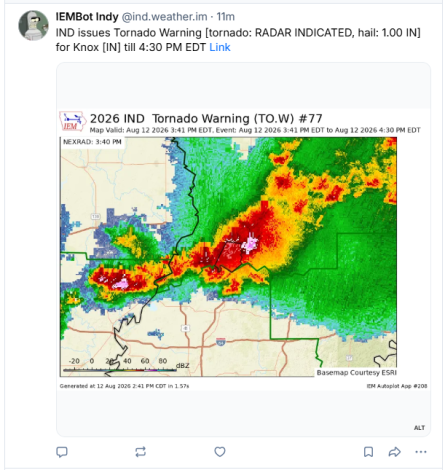
When I’m available, I share information such as mesoscale discussions, watches, etc. on various social media channels. I’m rarely available, however, to share National Weather Service (NWS) warnings in a timely manner. Fortunately, such warnings get posted automatcially to certain social media platforms by bots created and operated by Iowa State University’s Iowa Environmental Mesonet.
To find them, you must know which NWS weather forecast office (WFO) provides warnings for your county and you need to know the social media accounts in which that WFO’s alerts get automatically posted.
Start by finding your county on the list below to learn which WFO serves that county. Beneath that list are lists of accounts to follow on each of severel differnet social media platforms.
| Indiana County | WFO |
| Adams | Northern Indiana (IWX) |
| Allen | Northern Indiana (IWX) |
| Bartholomew | Indianapolis (IND) |
| Benton | Chicago (LOT) |
| Blackford | Northern Indiana (IWX) |
| Boone | Indianapolis (IND) |
| Brown | Indianapolis (IND) |
| Carroll | Indianapolis (IND) |
| Cass | Northern Indiana (IWX) |
| Clark | Louisville (LMK) |
| Clay | Indianapolis (IND) |
| Clinton | Indianapolis (IND) |
| Crawford | Louisville (LMK) |
| Daviess | Indianapolis (IND) |
| Dearborn | Wilmington, OH (ILN) |
| Decatur | Indianapolis (IND) |
| DeKalb | Northern Indiana (IWX) |
| Delaware | Indianapolis (IND) |
| Dubois | Louisville (LMK) |
| Elkhart | Northern Indiana (IWX) |
| Fayette | Wilmington, OH (ILN) |
| Floyd | Louisville (LMK) |
| Fountain | Indianapolis (IND) |
| Franklin | Wilmington, OH (ILN) |
| Fulton | Northern Indiana (IWX) |
| Gibson | Paducah, KY (PAH) |
| Grant | Northern Indiana (IWX) |
| Greene | Indianapolis (IND) |
| Hamilton | Indianapolis (IND) |
| Hancock | Indianapolis (IND) |
| Harrison | Louisville (LMK) |
| Hendricks | Indianapolis (IND) |
| Henry | Indianapolis (IND) |
| Howard | Indianapolis (IND) |
| Huntington | Northern Indiana (IWX) |
| Jackson | Indianapolis (IND) |
| Jasper | Chicago (LOT) |
| Jay | Northern Indiana (IWX) |
| Jefferson | Louisville (LMK) |
| Jennings | Indianapolis (IND) |
| Johnson | Indianapolis (IND) |
| Knox | Indianapolis (IND) |
| Kosciusko | Northern Indiana (IWX) |
| LaGrange | Northern Indiana (IWX) |
| Lake | Chicago (LOT) |
| LaPorte | Northern Indiana (IWX) |
| Lawrence | Indianapolis (IND) |
| Madison | Indianapolis (IND) |
| Marion | Indianapolis (IND) |
| Marshall | Northern Indiana (IWX) |
| Martin | Indianapolis (IND) |
| Miami | Northern Indiana (IWX) |
| Monroe | Indianapolis (IND) |
| Montgomery | Indianapolis (IND) |
| Morgan | Indianapolis (IND) |
| Newton | Chicago (LOT) |
| Noble | Northern Indiana (IWX) |
| Ohio | Wilmington, OH (ILN) |
| Orange | Louisville (LMK) |
| Owen | Indianapolis (IND) |
| Parke | Indianapolis (IND) |
| Perry | Louisville (LMK) |
| Pike | Paducah, KY (PAH) |
| Porter | Chicago (LOT) |
| Posey | Paducah, KY (PAH) |
| Pulaski | Northern Indiana (IWX) |
| Putnam | Indianapolis (IND) |
| Randolph | Indianapolis (IND) |
| Ripley | Wilmington, OH (ILN) |
| Rush | Indianapolis (IND) |
| St. Joseph | Northern Indiana (IWX) |
| Scott | Louisville (LMK) |
| Shelby | Indianapolis (IND) |
| Spencer | Paducah, KY (PAH) |
| Starke | Northern Indiana (IWX) |
| Steuben | Northern Indiana (IWX) |
| Sullivan | Indianapolis (IND) |
| Switzerland | Wilmington, OH (ILN) |
| Tippecanoe | Indianapolis (IND) |
| Tipton | Indianapolis (IND) |
| Union | Wilmington, OH (ILN) |
| Vanderburgh | Paducah, KY (PAH) |
| Vermillion | Indianapolis (IND) |
| Vigo | Indianapolis (IND) |
| Wabash | Northern Indiana (IWX) |
| Warren | Indianapolis (IND) |
| Warrick | Paducah, KY (PAH) |
| Washington | Louisville (LMK) |
| Wayne | Wilmington, OH (ILN) |
| Wells | Northern Indiana (IWX) |
| White | Northern Indiana (IWX) |
| Whitley | Northern Indiana (IWX) |
Bluesky
If you use the social media platform Bluesky, follow the IEMbot account below that’s associated with your WFO from the list above:
| WFO | Bluesky IEMbot account |
| Chicago | @lot.weather.im |
| Indianapolis | @ind.weather.im |
| Louisville | @lmk.weather.im |
| Northern Indiana | @iwx.weather.im |
| Paducah | @pah.weather.im |
| Wilmington, Ohio | @iln.weather.im |
X.com (formerly Twitter)
On X.com, you can follow two different accounts for each WFO. Posts in each WFO’s official account are created manually by NWS meteorologists as they have time. Posts in the IEMbot account are created automatically from the alerts that the WFO creates.
| WFO | X.com official account | X.com IEMbot account |
| Chicago | @NWSChicago | @iembot_lot |
| Indianapolis | @NWSIndianapolis | @iembot_ind |
| Louisville | @NWSLouisville | @iembot_lmk |
| Northern Indiana | @NWSIWX | @iembot_iwx |
| Paducah | @NWSPaducah | @iembot_pah |
| Wilmington, Ohio | @NWSILN | @iembot_iln |
Mastodon
Iowa Environmental Mesonet does not appear to have created IEMbot accounts on Mastodon, but my Mastodon account automatically posts IEMbot data for every Indiana county. You may follow it at @jayfarlow@wx.social.
I”m not aware of any Facebook account that automatically posts all the warnings of WFOs that serve Indiana. In addition, Facebook’s algorithm can create significant delays. Each WFO has it’s own Facebook account (below) to which meteorologists manually post valuable information, so these are nonetheless worth following.
| WFO | Facebook page |
| Chicago | https://www.facebook.com/NWSChicago |
| Indianapolis | https://www.facebook.com/NWSIndianapolis |
| Louisville | https://www.facebook.com/NWSLouisville/ |
| Northern Indiana | https://www.facebook.com/NWSNorthernIndiana/ |
| Paducah | https://www.facebook.com/NWSPaducah/ |
| Wilmington, Ohio | https://www.facebook.com/NWSWilmingtonOH/ |
Web
Every WFO also has its own web page that’s worth bookmarking and visiting on a regular basis.

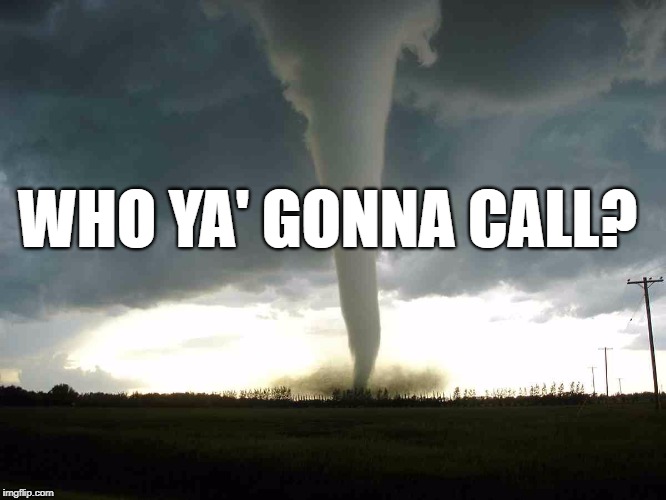 After a small tornado outbreak in Indiana and neighboring states yesterday, I’ve been looking at some tornado videos published by storm chasers. On at least two of them, one can hear on the audio track references to calling 911 to report the tornado. On one, you can hear a chaser instructing a public safety answering point (PSAP) operator to activate warning sirens.