Tag Archives: Storm Chasers

Why do some storm chasers call 911 vs NWS?

After a small tornado outbreak in Indiana and neighboring states yesterday, I’ve been looking at some tornado videos published by storm chasers. On at least two of them, one can hear on the audio track references to calling 911 to report the tornado. On one, you can hear a chaser instructing a public safety answering point (PSAP) operator to activate warning sirens.

Here’s my question: Why would storm chasers — who one would expect to be familiar with the National Weather Service (NWS) warning system — call 911 instead of the NWS?

Why would storm chasers — who one would expect to be familiar with the National Weather Service (NWS) warning system — call 911 instead of the NWS?

Sure, a call to the local PSAP might lead to activation of outdoor warning sirens, which might alert some nearby residents — especially ones who are outdoors — that something is going on. But it won’t lead to activation of NOAA weather radios, wireless emergency alerts on cellular phones, or alerts on broadcast channels until and unless the NWS knows about the tornado and issues an official tornado warning.

You might think that a call to 911 will get a report to the NWS. In reality, that’s not necessarily true. I’ve attended several meetings of an NWS integrated warning team, where PSAP representatives have repeatedly said that during periods of severe weather, they’re so busy answering phones, that they don’t have time to  call NWS. And an NWS warning coordination meteorologist has personally told me that his office yearns to know what citizens are reporting to 911, but can’t get the information.

Granted, calling 911 is easy, especially for chasers whose anxiety levels have reached a near panic stage as they stare down tornadoes. After all, calling 911 when something bad happens is almost a reflex. But a single call to the NWS would get life-saving information to a whole lot more people who are in the path of the storm.

There is a challenge, though, especially for chasers who are always moving from county to county (and for some, state to state) as they try to get in position to see tornadoes. They must always know exactly where they are and they must know which NWS office to call. Adjacent counties are not always served by the same NWS office.

The first part (knowing exactly where you are) is challenging enough, when you’re driving through unfamiliar territory. I’ve heard numerous spotters and chasers, who, while trying to make a report to NWS offices, were unable to say exactly where they were, much less where the funnel cloud or tornado was. Knowing what county your are in and knowing what NWS office serves that county is even more difficult. In truth, any NWS office will accept a tornado report from outside its area and get that information immediately to the correct office. So calling the “wrong” NWS office is probably still better than calling 911, when it comes to warning the most people.

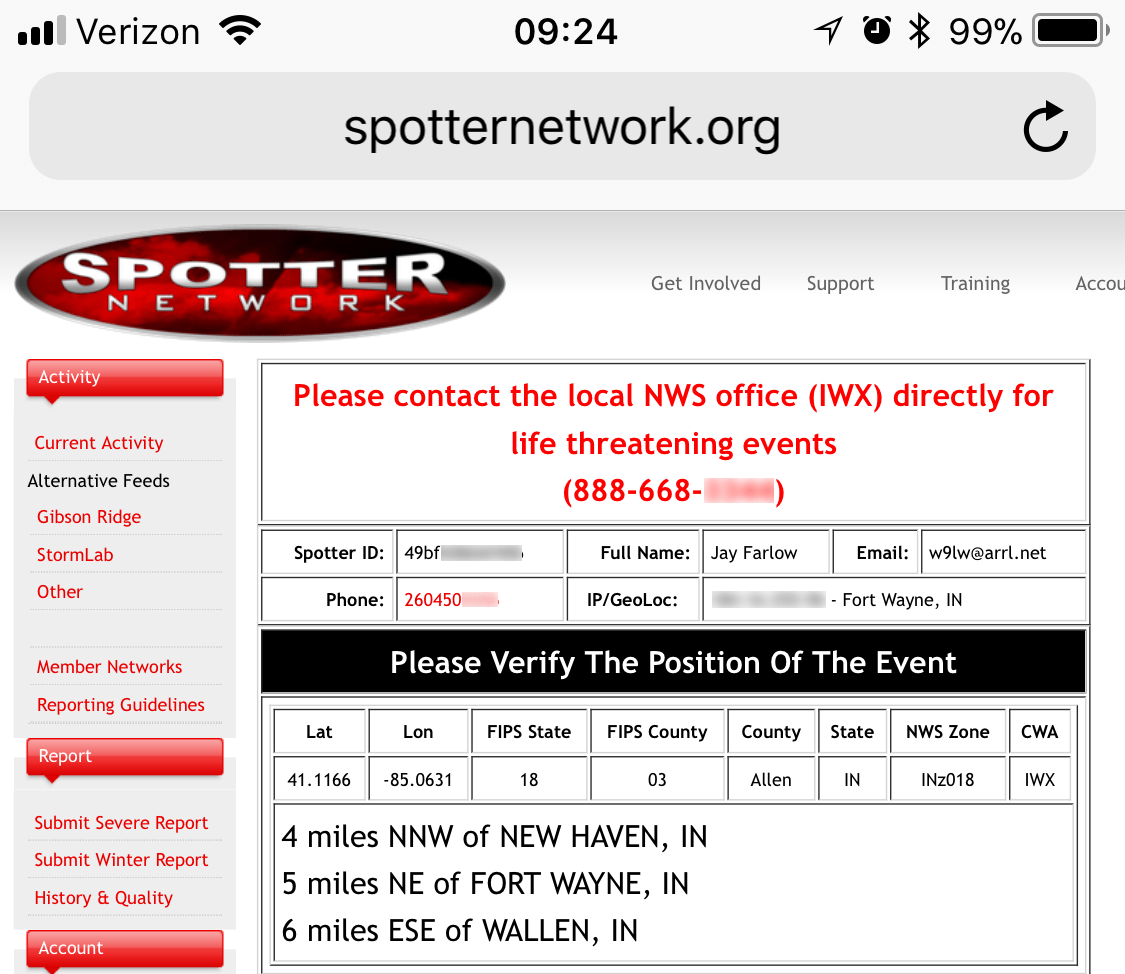
But there’s an even better solution. Members of Spotter Network, Inc. can use a combination of location-reporting software on their smartphones and the Spotter Network website to learn immediately the phone number of the NWS office that covers whatever location they’re in at the moment.
University demonstrates questionable understanding of tornado warnings https://farlowconsulting.com/2017/11/05/university-demonstrates-questionable-understanding-of-tornado-warnings/
The Spotter Network website can tell members where they are, which NWS office to call, and the phone number for that office.

By using the location-beaconing software, staying logged into the Spotter Network website and bookmarking the “Submit Severe Report” page above, chasers and spotters can learn the best NWS number to call with a couple touches of their smartphones. The result will be warning a lot more people a lot sooner than calling 911 can.

What’s the #1 source for national weather?

Amateur-run Facebook pages should not mislead readers into believing that their information is better than that of the National Weather ServiceShould a Facebook page run by amateur storm chasers promote itself as the best source for weather information? I can’t help but wonder how many (if any) naïve Facebook users foolishly rely on such pages for time-critical safety information, in lieu of the National Weather Service (NWS).

Recently, a Facebook page distributed the graphic above. I’ve blurred out identifying information, because who it was doesn’t matter to the point of this article. But the headline, “The #1 Source for National Weather” certainly caught my eye.

I’ve tried multiple times to contact the owners of the Facebook page that published that graphic. I sent a Facebook message and sent an email message to the email address on their website. I’ve received no response. So, all I know about them is what I see online.

From what I see, both the Facebook page and associated website are published by a group of amateur storm chasers, none of whom appear to have a meteorology degree.

In the U.S., only one source of weather information has the authority to issue the official watches and warnings that trigger weather radios, etc.

Don’t read what I’m not writing! There’s nothing wrong with an amateur-run Facebook page or website distributing interesting or important weather information. I do it all the time on Facebook, this blog, Twitter, etc. What I don’t do, however, is claim that my information is any better than others’.

Why? Because I don’t want anyone to assume that my blog, Facebook page or Twitter feed (or anyone’s for that matter) is a safe and reliable way to get timely, live-saving weather alerts, especially NWS warnings. Not even the NWS’ own Facebook and Twitter feeds are timely enough for that (yet).

That’s also why I consistently encourage readers – for their safety – to maintain timely access to NWS products (e.g. via NOAA Weather Radio, smartphone apps triggered by NWS products, Wireless Emergency Alerts, etc.).

All of us who publish weather information on social media and other Internet channels have a responsibility to inform and remind readers that in the U.S., only one source of weather information has the authority to issue the official watches and warnings that trigger weather radios, etc.: The National Weather Service. Likewise, we must not publish anything that could potentially mislead readers into believing that our social media feeds can keep them as safe as do directly received NWS warnings.

Our readers’ lives could depend on it!

What do you think? Use this blog’s comment function to let us know.

A weather safety tip you might not have thought of: Footwear

Photo of feet wearing flip-flops with red X superimposed. Flip-flops are poor footwear for severe weather days. Indiana Severe Weather Preparedness Week. #INWxReady #WRNSandals, especially flip-flops, which are so popular when the weather is warm, are poor choices for severe weather days.

My feet get warm easily. I have a pair of Chacos brand sandals that I wear almost every day during warm weather. But not on days that I might need to serve as a storm spotter.

If severe weather is coming our way, I usually change into a sturdy pair of ankle-supporting hunting boots I bought on sale at Cabela’s, even if I’ll be staying home during the storm.

Why? On word: debris.

National Weather Service photo

After a storm passes, I might have to walk through storm debris, which can include pieces of trees and pieces of buildings. The walking surface might be uneven. Some of the debris might have sharp edges.

I choose to protect my feet from all that, a practice I learned back in the 90s when I served as an emergency medical technician and communications technician on a Disaster Medical Assistance Team. It’s how I dressed my feet every day, even in tropical weather when assisting the victims of Hurricanes Andrew and Marilyn.

My advice: If you’re a storm spotter or storm chaser, get yourself a good pair of boots to wear anytime you’re in the field, even on hot, humid days. And no matter who you are, if you ever have to take shelter in your house from a coming storm, take the most protective footwear you have with you to the basement, interior room, etc. Put them on after the storm, before you step outside to survey the damage. Your feet will be much safer.