All posts by Jay Farlow

I'm Jay Farlow. W9LW is my amateur (ham) radio call sign. I've been a ham since 1973. I've been a volunteer storm spotter for the National Weather Service SKYWARN program since the 1970s. I've also been a volunteer EMT and firefighter and member of a disaster medical assistance team. I advise the leadership team of Associated Churches Active in Disaster, a ministry of Associate Churches of Fort Wayne and Allen County. Learn more about w9lw at www.qrz.com/db/w9lw.

Fort Wayne organization to host class for volunteer storm spotters

Speakers to include meteorologists from four TV stations

Collaborating for public safety: Meteorologists from four competing Fort Wayne TV stations meet with ARES leaders to help plan storm spotter education. Counterclockwise from lower left: Jim Moehring, KB9WWM, ARES emergency coordinator; Caleb Saylor Fox 55 Weekend Meteorologist; Nicholas Ferreri, WANE 15 Chief Meteorologist; Jon Wilson, Fort Wayne's NBC Weekend Meteorologist; Caleb Chevalier, ABC21 Weekend Morning Meteorologist. Photo by Jay Farlow, ARES Assistant Emergency Coordinator
Collaborating for public safety: Meteorologists from four competing Fort Wayne TV stations meet with ARES leaders to help plan storm spotter education. Counterclockwise from lower left: Jim Moehring, ARES emergency coordinator; Caleb Saylor, Fox 55 Weekend Meteorologist; Nicholas Ferreri, WANE 15 Chief Meteorologist; Jon Wilson, Fort Wayne’s NBC Weekend Meteorologist; Caleb Chevalier, ABC21 Weekend Morning Meteorologist. Photo by Jay Farlow, ARES Assistant Emergency Coordinator

Jan. 25, 2019 – Fort Wayne – A local organization invites anyone who is interested in weather to attend a free class on how to recognize and report severe weather phenomena to benefit public safety. The Allen County branch of the national Amateur Radio Emergency Service® (ACARES) will host the class at the Allen County Public Library, 900 Library Plaza, Fort Wayne, Thursday, Feb. 21 at 6:30 p.m. Scheduled speakers include meteorologists from ABC21, Fort Wayne’s NBC, Fox 55 and WANE 15. Allen County Office of Homeland Security director Bernie Beier and Consolidated Communications Partnership deputy director John Chavez also plan to speak.

The class is free and open to the general public, but seating is limited. ACARES therefore requests all who plan to attend, to register in advance at https://www.eventbrite.com/e/allen-county-storm-spotter-education-tickets-54685721465

“This two-hour class will provide attendees the knowledge they need to help protect their communities from severe weather like tornadoes,” said Jim Moehring, emergency coordinator (team leader), ACARES. “Although we are a ham radio organization, people need not be hams to be storm spotters, so we welcome anyone who is interested in weather.”

Moehring said the “ground truth” that volunteer spotters provide is essential to the process through which the National Weather Service (NWS) issues storm warnings. He pointed out that this remains true despite advances in weather radar, because the beam from the NWS radar site near North Webster is 2,500 feet or more above the ground by the time it reaches Allen County.

Traditionally, meteorologists from the NWS Northern Indiana office near North Webster have presented spotter training every spring in Fort Wayne. Changes in the office’s responsibilities, however, led it to change its training schedule. As a result, NWS meteorologists won’t be in Fort Wayne until autumn of 2019 and then not again until spring of 2021.

“We wanted to assure that our members, and members of the general public have a chance to receive storm spotter education before this spring’s severe weather season,” Moehring said. “We therefore decided to devote our February meeting to a spotter class and to invite everyone to attend. Because NWS meteorologists aren’t available, we’re thrilled that four TV stations in Fort Wayne are sending meteorologists to help teach the weather-related material.”

A complete list of speakers and their topics follows:

  • Jim Moehring, Allen County ARES emergency coordinator (team leader): Introduction to the NWS SKYWARN program and the importance of volunteer storm spotters.
  • Jay Farlow, ACARES assistant emergency coordinator for SKYWARN: How storm warnings are issued and distributed. Also, storm spotter reporting methods and best practices.
  • Charles Ward, experienced storm spotter: Best practices to remain safe while storm spotting.
  • Bernie Beier, Allen County Office of Homeland Security director: The role of the Allen County Office of Homeland Security with regard to severe weather.
  • John Chavez, Consolidated Communications Partnership deputy director: The role of the Consolidated Communication Partnership (911/dispatch) in severe weather events.
  • Caleb Saylor, Fox 55 weekend meteorologist: Thunderstorm basics, including how storms form and become severe.
  • Caleb Chevalier, ABC21 weekend morning meteorologist: Types of thunderstorms, including those most likely to create tornadoes. Also, radar apps and interpretation
  • Jon Wilson, Fort Wayne’s NBC weekend meteorologist: Thunderstorm hazards, including straight-line winds, large hail, flash flooding and tornadoes.
  • Nicholas Ferreri, WANE 15 chief meteorologist: Cloud identification, including distinguishing scary-looking but benign weather from true threats that spotters should report.

About the Amateur Radio Emergency Service

The Amateur Radio Emergency Service® (ARES) is a program of ARRL, the national association for amateur radio®. ARES establishes teams of volunteer, licensed amateur (ham) radio operators in counties throughout the country, each of which is led by an emergency coordinator. These volunteer teams train and practice to provide communication services to their communities in the event of a disaster. Through a memorandum of understanding signed by ARRL and the National Weather Service (NWS), ARES volunteers also commit to communicating weather information that assists the NWS in the creation of weather warnings. In addition, ARES volunteers practice their communication skills by providing two-way radio communications at public events, such as marathons, walk-a-thons, etc. More information about ARES is available on the ARRL website at http://www.arrl.org/ares.

Media Contact

Jay Farlow, volunteer public information officer, ARRL
arsw9lw@gmail.com

WeatherBrains podcast features amateur radio’s role in the weather enterprise

This blog’s author, Jay Farlow, W9LW, joining the WeatherBrains podcast Jan. 7, 2019, via Google Hangouts from his office/radio shack at home in Fort Wayne, Indiana.

A popular, weather-related podcast recently recorded an episode devoted to the role of amateur (ham) radio in the weather enterprise, especially storm spotting. WeatherBrains is a long-running, well-respected podcast hosted by Alabama broadcast meteorologist James Spann. It recorded the ham radio podcast January 7.

Ham radio has been deeply involved in the National Weather Service’s (NWS) SKYWARN® program since its inception, according to research done by Brian E. Smith, the warning coordination meteorologist at the NWS Omaha/Valley weather forecast office (WFO) in Nebraska. During the infamous Palm Sunday tornado outbreak of 1965, a tornado did F4 damage in northern Toledo, Ohio. Afterward, a ham who was also a meteorologist in the Toledo office of what was then called the U.S. Weather Bureau — Merle Kachenmeister, WA8EWW — organized ham radio operators in his area to report severe weather to the Toledo office via radio. This is considered the birth of the SKYWARN program, according to Smith.

WeatherBrains episode number 677 is available for viewing or listening on the the podcast’s website. Listeners can also access the audio-only version on their mobile devices via their favorite podcast apps.

The author of this blog was one of the guests who WeatherBrains invited to discuss ham radio. Other guests included Jeff Stapel, W8SWX of the Muskegon, Michigan SKYWARN organization and Rob Macedo, KD1CY, who is both the Section Emergency Coordinator of the ARRL Eastern Massachusetts section and director of operations for the VOIP Hurricane Net.

During the show, I mentioned several resources that might be valuable to audience members. For your convenience, I’ve listed them below:

  • ARRL, the national association for amateur radio®: This website contains a wealth of information about amateur radio, what hams do, and how to become a licensed ham radio operator.
  • The tornado outbreak of Aug. 24, 2016: This page on the website of the NWS northern Indiana WFO includes the radar rotation tracks I showed during the podcast, as well as other information about how the outbreak affected my home area.
  • ARRL Ham Radio License Manual: This book contains all the information you need to pass the exam and get your ham radio license, so you can join other storm spotters on the air.
  • Storm Spotting and Amateur Radio: This book is a valuable resource for anyone who is interested in either storm spotting or how to use ham radio while spotting. It includes information on resources, training, equipment, safety, storm spotter activation procedures and more.
  • Allen County (Ind.) SKYWARN Net Operations Manual: This PDF document discusses in great detail how the hams of the Fort Wayne and Allen County, Indiana area organize their SKYWARN net — i.e. on-air conference call — during severe weather events.

A couple resources I didn’t have time to get into regard equipment (although Rob mentioned some price ranges). Below are links to some equipment options you might consider, if you’re thinking about getting into ham radio:

  • Baofeng UV-5R handheld radio: Available on Amazon for only $25, this will get you on the air. Like any handheld radio, its geographical range is limited, but as long as you’re close enough to what hams call a “repeater” station, you can talk to people dozens of miles away.
  • AnyTone AT-778UV Mobile radio: Available on Amazon for $130, this radio mounts in your vehicle and connects to your vehicle’s 12-volt poser source. It transmits with 25 watts, versus the 5 watts of most handheld radios, enabling you to communicate while farther from the repeater station. It requires an external antenna, sold separately. Antenna options include those with temporary magnetic mounts and those that can mount more permanently on a trunk lid without drilling holes.

The “big three” brands of ham radio equipment are Icom, Kenwood and Yaesu. Their radios, while well respected, tend to be priced higher on the new market than the Chinese brands above. Note, however, that there’s a large market for pre-owned radios. These can be obtained through some dealers (who take trade-ins), at ham radio flea markets and through online auction sites.

Allen County Group to Host Spotter Training

Anyone can help protect their community from weather threats like tornadoes. In just a couple of hours, you can learn how severe weather forms, how to distinguish truly threatening weather from scary-looking but harmless clouds, and how to report severe weather so the rest of your community can be adequately warned.

The Allen County chapter of the Amateur Radio Emergency Service (ARES) invites all interested persons to attend its Feb. 21 meeting, from 6:30 to 8:30 p.m., at the main, downtown branch of the Allen County Public Library, The meeting will be devoted to severe weather and storm spotting. You don’t have to be a ham radio operator and you don’t need any prior knowledge of meteorology or communications.

Scheduled speakers include ABC21 Weekend Morning Meteorologist Caleb Chevalier, WANE 15 Chief Meteorologist Nicholas Ferreri, FOX 55 weekend Meteorologist Caleb Saylor, Fort Wayne’s NBC Weekend Meteorologist Jon Wilson, Allen County Office of Homeland Security director Bernie Beier, Consolidated Communications Partnership (911/public safety dispatch) director David Bubb, Allen County ARES team leader Jim Moehring and Allen County SKYWARN ham radio net manager Jay Farlow.

Although representatives of the National Weather Service (NWS) are not available for this meeting, we will follow the NWS SKYWARN curriculum with enhancements specific to Allen County. NWS does not plan to teach a spotter class in Allen County until autumn of 2019.

This event is free and only about 100 seats are available. If you plan to come, please register at https://www.eventbrite.com/e/allen-county-storm-spotter-education-tickets-54685721465, so ARES will know if registrations approach the room’s capacity.

This meeting will be valuable to anyone who is interested in severe weather, including those who have previously received storm spotter training. More information is available on the host’s Facebook page.

Info resources for SKYWARN storm spotters

Tonight, I was the guest speaker at a meeting of the Allen County Amateur Radio Technical Society on the topic in the title above. I promised the members present that they would not have to write down all the web URL’s I mentioned, because i’d post them here. Each item in the bulleted list below links directly to the respective online resource.

Do you really understand the danger of lightning?

lightning
PC: Mr. Shane Lear, Orange Australia. Creative Commons

We had a doozy of a lightning show in Fort Wayne tonight. Fortunately, it appears (at the time of this writing) that our immediate area sustained no significant storm damage. But tonight’s storm — and the way I saw people react to it — prompts me to share some life-or-death information about lightning.

All thunderstorms — including those that aren’t technically severe — produce lightning and are therefore dangerous.

Lightning kills

As of  this date, lightning has killed at least 15 people in the United States so far this year, according to National Weather Service (NWS) statistics.  They ranged in age from seven to 75. Three of the victims were women, The rest were men and a boy. Many were doing some kind of gardening, like mowing, tree trimming, etc. All had one thing in common; they were outdoors when lightning struck.

Needless deaths

Making these statistics even sadder is the fact that most lightning deaths are preventable. Rarely does a lightning bolt strike a person without lightning (and its accompanying thunder) first occurring some distance away. That’s why the NWS came up with the slogans, “when thunder roars, go indoors” and “see a flash, dash inside.” Many people who were killed by lightning simply didn’t seek appropriate shelter soon enough.

Important lightning facts

All thunderstorms — including those that aren’t technically severe — produce lightning and are therefore dangerous. So many thunderstorms happen every year that the NWS issues warnings only for those that it expects to produce damaging winds or gusts of at least 58 mph and/or hail of one inch or more in diameter. No matter how much lightning a storm produces, if it doesn’t have strong enough winds or big enough hail, it doesn’t get a severe thunderstorm warning. Nonetheless, it’s potentially deadly, because of its lightning.

Lightning can strike even if it’s not raining. In fact, it can strike as far as 10 miles from any rainfall.

If you can hear thunder, therefore, you are in danger, unless you are already in an appropriate shelter (see below).

Avoiding lightning strikes

Staying alive in a thunderstorm is relatively simple, according to an NWS brochure. If you hear thunder, even a distant rumble, seek safety immediately. Fully enclosed buildings with wiring and plumbing are best.

A hard-topped metal vehicle with the windows closed is also safe.

Sheds, picnic shelters, tents or covered porches do not protect you from lightning.

Stay inside until 30 minutes after the last rumble of thunder.

If you are at a sporting event and venue officials recommend taking shelter, do it. Many venues have access to lightning data and suspend competition and advise sheltering when the first strike is detected within a certain number of miles of the venue. Such policies, when heeded, help give spectators and participants adequate time to reach appropriate shelter.

Spread the word

Help stop needless lightning deaths by making sure your family and friends understand the danger and what to do. Share this helpful NWS website and/or one or more of the resources to which it links.


I’m a storm spotter, not a storm chaser!

Well-known tornado researcher Dr. Chuck Doswell

I can’t count the number of times I’ve gone out of my way to make sure people know I’m not a storm chaser. I’ll very likely stop doing that, however, in part because of something I heard renowned tornado researcher Dr. Chuck Doswell say this week on a podcast.

It’s well known that the behaviors of some storm chasers have created a negative image of the hobby. We frequently see stories of chasers taking risks that we might consider unacceptable, driving recklessly and/or causing traffic problems. It’s this negative image that made me want to distance myself from the chaser community.

This week, however, Doswell posited that there’s real value in storm chasing, even for (perhaps especially for) storm spotters.

“I’ve never had a problem with spotters who want to be chasers. In fact, I think it’s a great idea,” Doswell said on episode 635 of “WeatherBrains,” the weather podcast hosted by Alabama television meteorologist James Spann.

“Every time I go out (as a chaser), I see something I’ve never seen before,” Doswell continued. “If you’re just an ‘ordinary spotter,’ the number of storms that you would see in any given year is fairly small, unless it’s just a fantastically busy year in your neighborhood that year. But, as a chaser, you can sample more storms. If I’m out for two weeks, I’ll probably see 20, 30 different storms. And of those, maybe some fraction will be supercells and some fraction of those will produce tornadoes. But every year, then, I see a fairly large sample of storms. So, I’ve been doing this for more than 45 years, and so I’ve seen a lot of storms, and I’m still seeing things that I’ve never seen before.”

“So, chasing and spotting are not necessarily opposed to one another,” Doswell added. “I would recommend anyone who’s a serious spotter to go ahead and chase, if for no other reason than to expand their vocabulary of storms.”

WeatherBrains panelist Rick Smith, who works as warning coordination meteorologist at the National Weather Service office in Norman, Oklahoma, agreed. “The best spotters, I think, are the ones that are kind of the hybrid chasers and spotters.”

Doswell and Smith make an interesting point. There’s only so much a storm spotter can learn by looking at photos and video. Seeing the real thing in person would logically make it easier for a spotter to later recognize important storm features as a storm approaches the spotter’s home jurisdiction.

So, I hereby discontinue my previous efforts to distinguish myself from storm chasers. In fact, I’m seriously thinking about asking one of the accomplished chasers I know if I can go along on a chase sometime. Heck, if I ever have the spare cash, I might even buy a seat on a well-regarded storm chasing tour, like those offered by Tempest Tours (some of which Doswell himself leads) or the College of DuPage (which allows anyone to easily register as a student for that single class).

One thing you won’t see me doing is trying it on my own. Numerous experts in the field extolled the dangers of solo chasing, as did Dr. David Call of Ball State University during the recent Central Indiana Severe Weather Symposium in Indianapolis.

But perhaps in the future, you’ll hear me saying, “I’m a storm spotter and sometimes a chaser,” rather than the statement in the title of this blog post.

Wait, what? Feds say warning us about military attacks isn’t their job.

Tweet sent by Hawaii's Emergency Management Agency after it sent a false missile attack alert via the Emergency Alert System Jan. 13, 2018.
Tweet sent by Hawaii’s Emergency Management Agency after it sent a false missile attack alert via the Emergency Alert System Jan. 13, 2018.

Well, this is interesting and a bit surprising. NPR reported today that federal officials say it’s not their role to warn the public about missiles.

If the feds are the ones who can detect an attack, aren’t the feds the ones who should warn us about it?

Ever since I was a kid in the 1960s, I expected to hear directly from the federal government if the United States came under attack.

In the early 1950s, the federal government established the CONELRAD system, in part to enable the feds to continuously broadcast enemy attack information to the public using radio or TV stations. I remember that one of the first electronic kits I ever built was a CONELRAD detector, which would turn on a light if a radio station to which it was tuned went off the air. It wasn’t intended to be practical, but began to teach me about electronics and emergency communications.

The Emergency Broadcast System (EBS) replaced CONELRAD in 1953. Its purpose was similar to CONELRAD’s; “to provide the President of the United States with an expeditious method of communicating with the American public in the event of war, threat of war, or grave national crisis.” This meant the federal government was still acknowledging a responsibility to communicate such information directly to the public, vs. expecting states to do it.

I don’t know when the federal government handed off to states the task of alerting the public to military attacks (if you do, leave a comment). Perhaps it happened when the EBS morphed into our current Emergency Alert System (EAS) in 1997.  It seems ridiculous to me, however, because the ability to detect such attacks lies with the Department of Defense (a federal agency). If the feds are the ones who can detect an attack, aren’t the feds the ones who should warn us about it?

Earlier this month, U.S. Senators Brian Schatz (D-Hawai‘i), Kamala Harris (D-Calif.), and Cory Gardner (R-Colo.) introduced the Authenticating Local Emergencies and Real Threats (ALERT) Act (S.2385), legislation that would give the federal government the sole responsibility of alerting the public of a missile threat.  If you agree that military attack warnings should again come from the feds, drop a line to your U.S. senator and ask him or her to support  S.2385.


Why do some storm chasers call 911 vs NWS?

After a small tornado outbreak in Indiana and neighboring states yesterday, I’ve been looking at some tornado videos published by storm chasers. On at least two of them, one can hear on the audio track references to calling 911 to report the tornado. On one, you can hear a chaser instructing a public safety answering point (PSAP) operator to activate warning sirens.
Here’s my question: Why would storm chasers — who one would expect to be familiar with the National Weather Service (NWS) warning system — call 911 instead of the NWS?

Why would storm chasers — who one would expect to be familiar with the National Weather Service (NWS) warning system — call 911 instead of the NWS?

Sure, a call to the local PSAP might lead to activation of outdoor warning sirens, which might alert some nearby residents — especially ones who are outdoors — that something is going on. But it won’t lead to activation of NOAA weather radios, wireless emergency alerts on cellular phones, or alerts on broadcast channels until and unless the NWS knows about the tornado and issues an official tornado warning.

You might think that a call to 911 will get a report to the NWS. In reality, that’s not necessarily true. I’ve attended several meetings of an NWS integrated warning team, where PSAP representatives have repeatedly said that during periods of severe weather, they’re so busy answering phones, that they don’t have time to  call NWS. And an NWS warning coordination meteorologist has personally told me that his office yearns to know what citizens are reporting to 911, but can’t get the information.

Granted, calling 911 is easy, especially for chasers whose anxiety levels have reached a near panic stage as they stare down tornadoes. After all, calling 911 when something bad happens is almost a reflex. But a single call to the NWS would get life-saving information to a whole lot more people who are in the path of the storm.

There is a challenge, though, especially for chasers who are always moving from county to county (and for some, state to state) as they try to get in position to see tornadoes. They must always know exactly where they are and they must know which NWS office to call. Adjacent counties are not always served by the same NWS office.

The first part (knowing exactly where you are) is challenging enough, when you’re driving through unfamiliar territory. I’ve heard numerous spotters and chasers, who, while trying to make a report to NWS offices, were unable to say exactly where they were, much less where the funnel cloud or tornado was. Knowing what county your are in and knowing what NWS office serves that county is even more difficult. In truth, any NWS office will accept a tornado report from outside its area and get that information immediately to the correct office. So calling the “wrong” NWS office is probably still better than calling 911, when it comes to warning the most people.

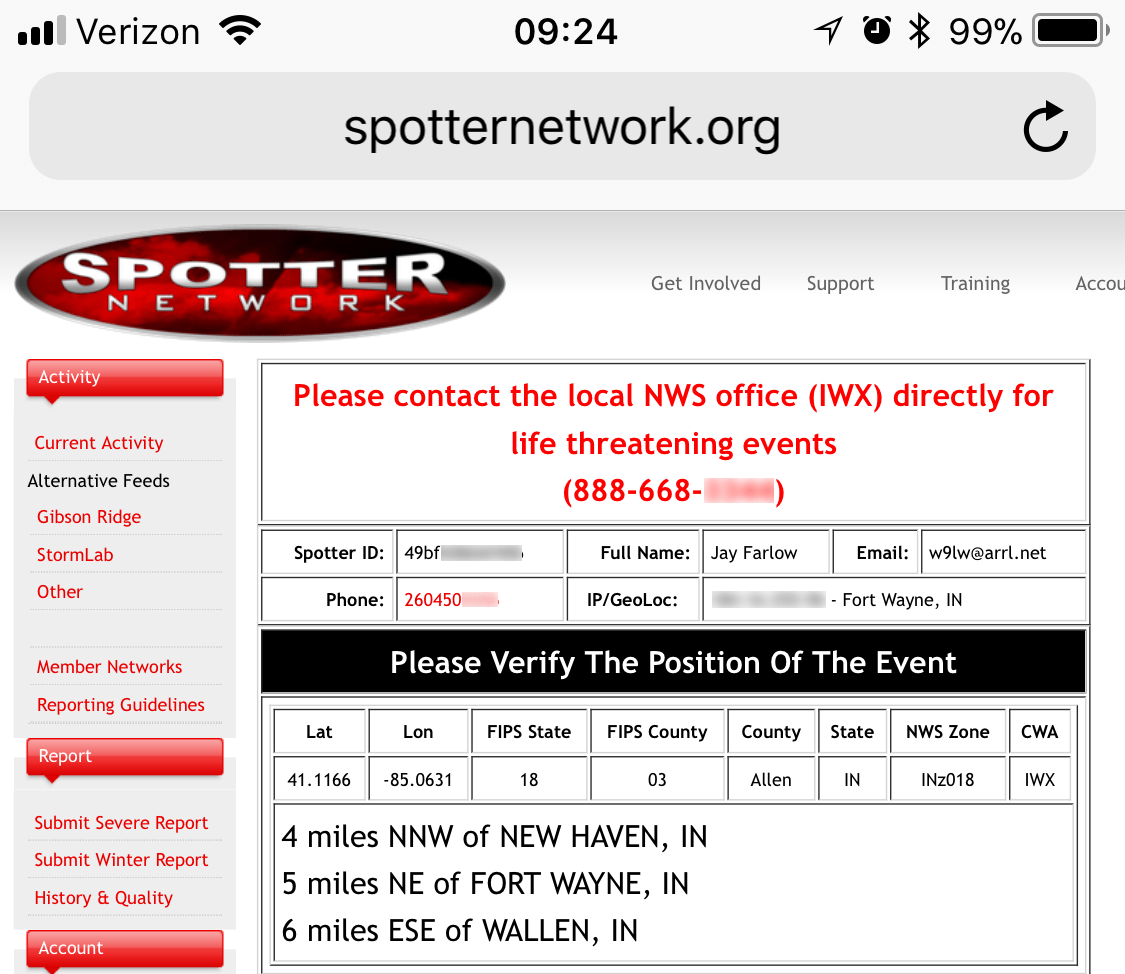
But there’s an even better solution. Members of Spotter Network, Inc. can use a combination of location-reporting software on their smartphones and the Spotter Network website to learn immediately the phone number of the NWS office that covers whatever location they’re in at the moment.

University demonstrates questionable understanding of tornado warnings https://farlowconsulting.com/2017/11/05/university-demonstrates-questionable-understanding-of-tornado-warnings/
The Spotter Network website can tell members where they are, which NWS office to call, and the phone number for that office.

By using the location-beaconing software, staying logged into the Spotter Network website and bookmarking the “Submit Severe Report” page above, chasers and spotters can learn the best NWS number to call with a couple touches of their smartphones. The result will be warning a lot more people a lot sooner than calling 911 can.

University demonstrates questionable understanding of tornado warnings

It’s really important that anyone who is in charge of the safety of an institution — a university campus, for example — maintain an updated, working knowledge of how weather warnings work. Tweets sent today by Indiana University today could lead one to believe that its campus safety staff could benefit from some education in that area.

At 1:19 p.m. EST, the Indianapolis office of the National Weather Service (NWS) issued a tornado warning that included a portion of southern Monroe County, Indiana.  The warning came with a polygon that clearly showed that the IU campus was not included.

Polygon associated with Nov. 5 tornado warning near Bloomington, IN. The National Weather Service issued the warning only for the area inside the red polygon.

In addition, the text of the warning indicated that “a severe thunderstorm capable of producing a tornado was located 12 miles northwest of Bedford, moving east at 30 mph.” In other words, the storm was not moving toward Bloomington or the IU campus (which is why NWS meteorologists drew the polygon as they did).

Six minutes after the NWS issued the warning, IU sent a tweet at 1:25 regarding what it called a “tornado warning for Bloomington.”

Cody Kirkpatrick, an IU lecturer in atmospheric science, attempted to clarify IU’s tweet:

The IU Twitter account replied:

Dr. Kirkpatrick knew what he was talking about. Those sending tweets on behalf of IU demonstrated ignorance of the National Weather Service’s “storm-based warning” system. When the NWS implemented that system a decade ago, it replaced the county-wide warnings to which IU’s tweet refers, with warnings based on polygons that indicate where the actual risk is.

In subsequent tweets, Dr. Kirkpatrick attempted to point that out, as well as the fact that IU’s original tweet was ambiguous. IU’s response:

But is warning people who are not at risk really better than warning only people who are truly at risk? Is doing so truly “safe,” or does it exacerbate existing challenges with getting people to respond appropriately to warnings?

The people at any institution like IU, who are in charge of disseminating public safety information, would do well to take full advantage of the informational resources that exist among their own faculty. Doing so could lead to better weather safety communications in the future.

An unexpected honor

2017 Weather-Ready Nation Ambassador of Excellence graphic

I was surprised and honored that this blog was chosen by the northern Indiana office of the National Weather  as a 2017 Weather-Ready Nation Ambassador of Excellence.

If your organization is interested in helping the National Weather Service spread important weather safety messages, check out the WRN Ambassador program.